
We're honored to feature new fiction by K.A. Liedel in Issue Two of Orson's Review. Issue Two of Orson's Review will be released on March 19th, 2019.
We're also very fortunate for the time K.A. took to sit down and chat with us about his journey as a photographer.
*The following interview involves Orson's Publishing (OP) and K.A. Liedel (KL).
OP: How did your journey with the written word begin?
KL: I concocted (and then summarily deleted) an uncountable number of stories before I thought I had any real writing talent, including a dust-laden historical fiction novel twenty-two-year-old me swore was the next War & Peace. It wasn’t until I finished devouring Stephen King’s On Writing, at age thirty, that I felt the cogs of creativity grinding into motion, tooth by tooth. I’ve been writing all my life, but, for better or worse, I’m a late bloomer at taking it seriously.
OP: Is fiction writing your primary occupation?
KL: One day, perhaps, but for now, the day job pays for the hobby. When the sun is up, I’m at the office; when it’s down, I’m bent over a computer screen, typing furiously, bathed in a nuclear-white glow. Sometimes it feels like being a writer necessitates also being a night owl.
OP: What about “The Weekends Last Forever” are you most proud?
KL: I think I have a predilection to rely on violence to put the so-called “bow” on my stories. Instinctively, that’s how I get characters to transform and conflicts to resolve. It’s effective; it’s also predictable and boring. “Weekends” has no violence, relying solely on the escalation of addiction for conflict. It’s refreshing to write something much more intangible than a fist flying into a face or a trigger being pulled.
OP: Tell us about your writing process. Do you approach all pieces of writing in the same way?
KL: The writing process can be likened to a rash: I know it’s an idea worth pursuing when it keeps itching, day after day after day. I think about, pour over it, suffer through it. And then when enough’s enough, finally I apply the Calamine lotion: sitting down and typing the damn thing.
OP: As a child, what did you want to be when you grew up? How has that impacted your writing?
KL: The first thing I ever wanted to be was an astronaut, a reliable cliché for a young American boy. But though I quickly grew out of it, the romanticism of the Space Age still haunts me, among other 20th century shibboleths. Things like the World Wars, and dieselpunk, and Art Deco. These feel like collective memories, of sorts—something I’ve never lived, but still recollect, absorbing it from culture and media and stories. The idea of heroism and pioneers, imperfect and lost, trapped in another age. I suppose that longing informs everything I write.
OP: Tell us about the biggest sacrifice you’ve made while pursuing writing.
KL: Sleep!
OP: How many books do you read in a year?
KL: I would say anywhere from five to eight. I’m a slow reader, and have a penchant for sprawling nonfiction. It took me a whole year to read Max Hastings’s Inferno, which is about 800 pages. But I have to say, that was a year well spent!
OP: Do you attend readings? If so, tell us about the best one you’ve ever attended -- what made it so good?
KL: I’m a bit of a recluse, so I attend very little. (Yes, this is me self-scolding.) I admire anyone who can go and read aloud from a book, whether it’s their own or someone else’s. Reading is a private endeavor to me, and while I think sharing it with a group is a noble task, doing it well seems like it’d take a Herculean effort.
OP: What do you want most out of your literary community?
KL: When it comes to writers helping other writers, honesty is important. Encouragement isn’t useful without a little bit of hard advice in tow. It’s one thing to say, “keep trying.” It’s another to say “keep trying, but every rejection will sting, and you’ll have to do your damnedest to get back up on the wagon afterward.” There’s skill to winning, but also skill to losing the right way so you’re more likely to win the next time. It’s something everyone must learn.
OP: Do you believe that an MFA is crucial to success as a writer today?
KL: I don’t, though I do think it can have a positive impact. Certainly it’s not a necessity, but then, there’s nothing to lose and everything to gain by pursuing one.
OP: What do you cross your fingers for as a writer?
KL: Having suffered under the universal cross of rejection, I’m convinced that what writers want, more than anything else, is an editor who truly loves their work. If you can find someone who sees your talent more lucidly than you do, and is prepared to nurture and advance it, never ever let go of them!
OP: Where do you see your journey with the written word going?
KL: My fear as a writer is that my ideas will die with me. If nothing else, I hope I can get as many down as possible, as best as I am able, in the short time I have. If just one person picks it up, a week later, a year, a century, to read and enjoy and think about, then it’s worth the trouble to jot down. That’s all we can truly hope for: to reach someone besides ourselves and add another color to their lives, lending some small dimension, seen or unseen. That’s what the written word has done for me; why not repay the favor?
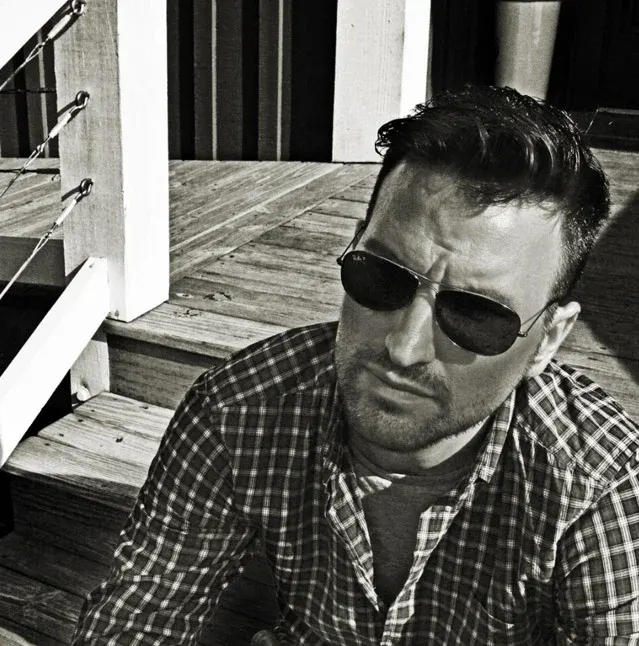
K. A. Liedel is an emerging author based in Delaware and a former staff writer for Slant Magazine. His short fiction has appeared in numerous journals, including the recent dark literature anthology Coffin Bell: One. You can find more of his work at www.kaliedel.com.
Be sure to check out K.A.’s latest fiction in Issue Two of Orson’s Review.