
We're honored to feature new poetry by Ren Pike in Issue Three of Orson's Review. Issue Three of Orson's Review was published on September 24th, 2019.
We're also very fortunate for the time Ren took to chat with us about the poet’s journey. Check out the discussion below.
*The following interview involves Orson's Publishing (OP) and Ren Pike (RP).
OP: How did your journey with the written word begin?
RP: It feels like I've always been writing poetry and prose. But my earliest memory of writing was when I did the Writer badge in Guiding at age 8. The badge tester took my writing seriously. She interviewed me, made me feel like my story had value. She called me a writer. I believed her.
OP: Is being a poet your primary occupation?
RP: No. My day job is in information systems. I hold a BSc in Computer Science and Physics. I like that my data work uses a different part of my brain. So I have capacity to write before and after my IS job.
OP: What about these poems are you most proud?
RP: These poems both deal with water as witness—what it sees, what it knows. I'm proud of how each poem asks you to re-examine and re-interpret what flows around your everyday reality.
OP: Tell us about your writing process. Do you approach all pieces of writing in the same way?
RP: I tend to capture ideas and images in my notebook. And then sit for extended periods to reflect on where these bits are taking my thoughts. If one of those trails excites me, I usually end up writing a first draft. Then I refine and re-configure in various ways via major and minor versions.
OP: As a child, what did you want to be when you grew up? How has that impacted your writing?
RP: Astronaut. Cowboy. These were there early on. By the time I was in uni I'd learned that horses are nothing like bicycles. And astronauts were mostly men. But I did have capability in Math and Physics. And as I pursued that, I took electives in poetry, language. I'm lucky that my data work does not deplete my creative work.
OP: Tell us about the biggest sacrifice you’ve made while pursuing writing.
RP: Early on, I had the chance to be part of a writing group that was filled with writers who went on to regional, national and international success. My participation was ad hoc and quite brief. But it showed me how good fellow writers and excellent critique could motivate and improve one's work. I ended up moving away for income reasons and gave up that opportunity. It was a sacrifice that I only came to fully realize much later.
OP: How many books do you read in a year?
RP: Haha. I start at least 70. I finish probably 30-40. I give a book 50 pages or 3 poems. If it doesn't engage me, then I move on. No harm. No foul. Novels get passed on when completed or dropped. Poetry, I keep, unless I truly have no handles by which to grok the poet's work.
OP: Do you attend poetry readings? If so, tell us about the best one you’ve ever attended—what made it so good?
RP: I've lived internationally and remotely so I've rarely attended readings. But I'd like to attend more. Since I only decided to attempt publishing in 2019, I'm only now really learning about these events. I've attended some via live stream. It's great when that is available.
OP: What do you want most out of your literary community?
RP: I would very much like a local writers group that I can join or form. I've been very lucky to have this wish partly filled via virtual meetings with writers in other locations.
OP: Do you believe that an MFA is crucial to success as a poet today?
RP: Success is a personal thing. Different definitions for different people. Perhaps some kinds of success are facilitated by an MFA. But my life experience has been that for most goals, there are multiple possible paths to success.
OP: What do you cross your fingers for as a poet?
RP: That the poem I write which makes my system zing, is picked up by some stranger and we share a moment of impromptu, temporally-disjoint intimacy, filled with bursts of existential synthesis.
OP: Where do you see your journey with the written word going
RP. This whole publishing submission process has spurred me to look into journals that I may never have found organically. I'm reading such outstanding pieces. It's just pumped up my desire to write and read more. This expanding poetry universe is such a gift. I hope to keep being inspired to step up, step out.
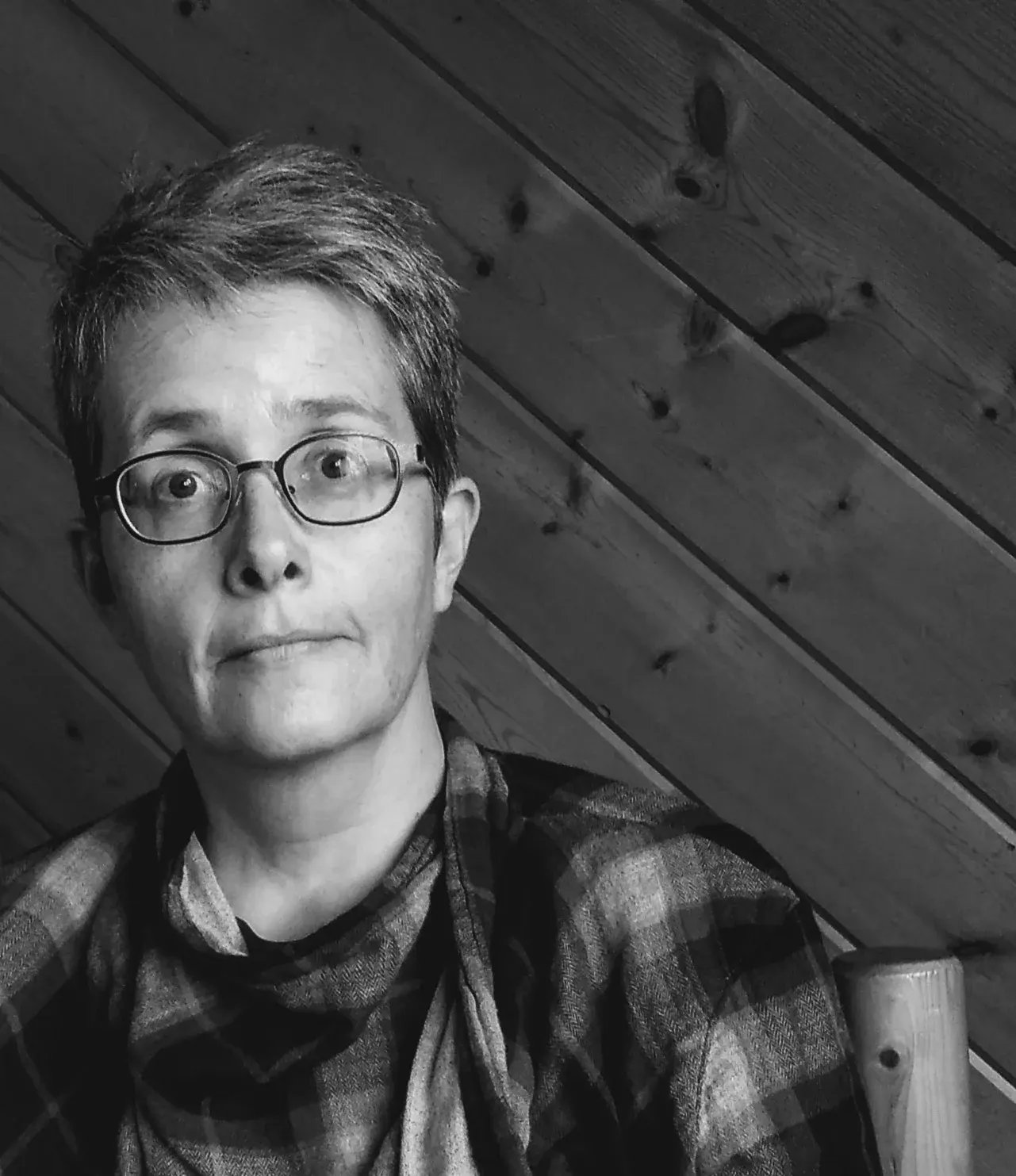
Ren Pike is originally from Newfoundland. Through sheer luck, she was born into family who understood the exceptional value of a library card. She has completed physics, computer science and education degrees, as well as a poetry course or two. She's worked at a variety of jobs, in a bazillion different places. Remote and urban. Foreign and domestic. Right now, she's helping community-minded non-profits wring meaning from data in Calgary, Canada. She writes, whenever possible. Her work has been published in ANTILANG and GYROSCOPE REVIEW. She can be found on Twitter @sputta
Be sure to check out Ren’s poetry in Issue Three of Orson’s Review.