

We're honored to feature "Fresh II" by David Rodriguez in Issue One of Orson's Review. We're also very fortunate for the time David took to sit down and chat with us about his journey as a photographer.
*The following interview involves Orson's Publishing (OP) and David Rodriguez (DR).
OP: How did your journey with photography begin?
DR: From an early age, I have always been attracted to the art world, but my love for photography didn´t start until 2013, the year I bought my first reflex camera, and I began to explore my attraction to art. Shortly afterwards, I began to train myself through several courses, and also in a self-taught way. While I was studying, I discovered new photographers. One day, I discovered Guy Bourdin and a photo that fascinated me enormously. In the picture, there was a girl under the water with her eyes and mouth open. I was enthralled with this image instantly, and this is how I came up with the idea for the "Fresh" series. Then, I did the shooting, taking advantage of a summer day in which the sun was at its peak.
OP: Is photography your occupation?
DR: Actually, my main occupation is working as a psychologist. Although I like my profession, as a child I always felt that there was something within me that needed to be expressed, and that psychology hasn’t helped to release. Thanks to photography, I have been able to cover this gap, and now, I am at a point in my life where I feel complete. When I take the camera, I feel that I have no pressure, I feel free to express myself and that comforts me. It is a nice feeling.
OP: What about these photos are you most proud?
DR: Of the works that I have done so far, I’m proud of "Fresh II" and "Pool". I think they are my most complete works and they define my photographic style best. In both, I have been able to capture everything that I imagined in my head. Water has always been a source of inspiration for me. Series like “Fresh” (I and II) or “Pool” are clear examples of this influence. It is possible that because of living on an island, it has always been a very common element in my life.
OP: Tell us about your process. Do you approach all photographs in the same way?
DR: I like to photograph people. Each person inspires me in a different way, so before I do the shooting, I imagine how I would like to portray that someone. Then, I create a concept and imagine a story. I do not like to get attached to reality. Instead, I like to transform it, challenging the model with unusual situations. I play with the model, making each session a cultural encounter, but also an enriching and surprising experience for both of us. The use of the photography techniques I use, whether high speed, long exposure or others, is determined by the conceptual preconception I had in mind.
OP: As a child, what did you want to be when you grew up? How has that impacted your photography?
DR: I had clear in my mind that I wanted to study psychology when I was around 16 years old. Although as I said before, I had always been attracted to the art world, I never thought of living off it, because I saw it more as a hobby or as something secondary. Today this vision has changed, and creating has become an essential part of my life. Of course, having studied psychology has influenced my artistic outcome. Finding the emotional side of the images, the perception processes, the psychology of the colors, etc., are concepts that I have in mind when I create a photographic composition and I see a lot of relationship between both disciplines.
OP: Tell us about the biggest sacrifice you’ve made while pursuing photography.
DR: I do not really like to improvise, I usually plan my sessions so I do not leave anything to chance. However, working outdoors involves certain difficulties. You have to take into account the natural light you need, that it is not cloudy or windy etc. Sometimes certain unforeseen events happen and you have to return another day because that day you could not make the photos you were looking for. Once I was on a rock, by the sea and almost fell into the water with all my photographic equipment in search of a photo. Luckily, I did not fall into the water!
OP: Tell us about the best shoot you've ever been on. What made it so good?
DR: I have good memories of "Pool". This session took me two full days, but it was summer and the weather conditions were great. There was no pressure, just wanting to have fun and more fun. There is nothing like working with a certain freedom and enjoying what you are doing. The models seemed to have fun in the pool, there was a moment when they stopped feeling watched by the camera and then the magic came.
OP: What do you cross your fingers for as a photographer?
DR: I hope to continue evolving as a photographer. I would like to continue learning and creating with the same enthusiasm that I do today. Above all that, I would not like to lose the illusion and to keep on enjoying every shoot of my camera.
OP: Where do you see your journey with photography going?
DR: The truth is that I would like to live off photography. It would be a dream come true. However, currently, I also consider myself a lucky photographer because I don´t feel any pressure and I do what I really want to do. I think that having some freedom when developing a creative proposal is fundamental.
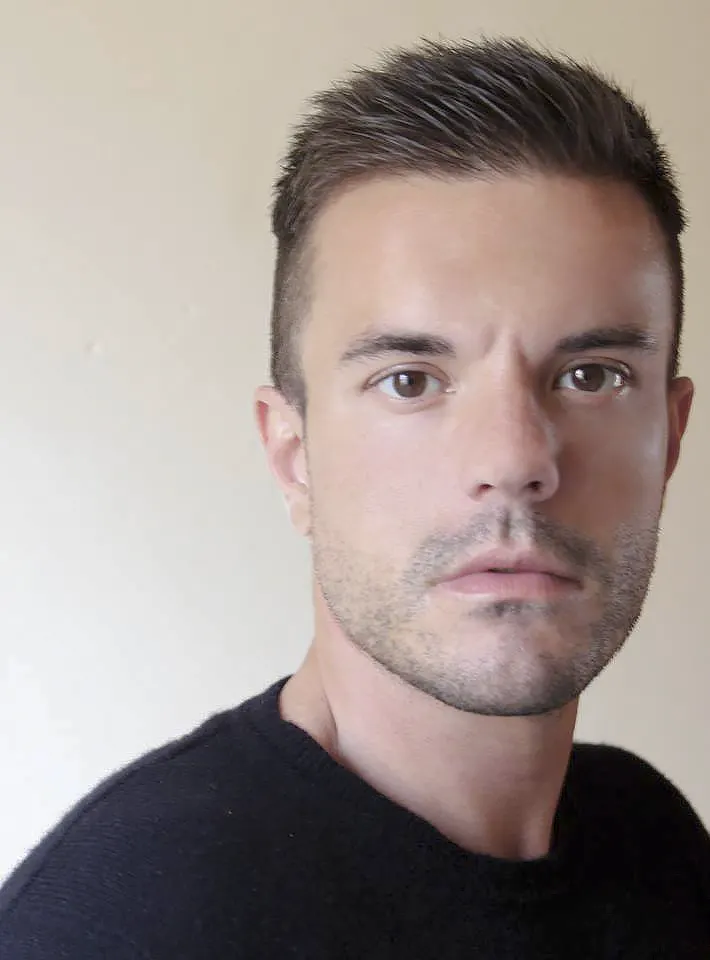
David Rodríguez is a photographer based in Spain. From an early age, he has always been attracted to the art world. He loves surreal photography and fashion photography. His main influences are Man Ray and Erwin Blumenfeld. One day he discovered a photo of Guy Bourdin that fascinated him enormously. In the picture, there was a girl under the water with her eyes and mouth open. David was enthralled with this image instantly, and used it as inspiration for the “Fresh” series.
He likes to photograph people, and feels very comfortable doing portraits, but he always try to explore the edges. That is the reason why he tries to look for risky compositions. His work has appeared in numerous publications, both online and print.
Be sure to check out "Fresh II" by David Rodriguez in Issue One of Orson's Review.