
We're honored to feature photography by Brian Michael Barbeito in Issue One of Orson's Review. We're also very fortunate for the time Brian took to sit down and chat with us about his journey as a photographer.
*The following interview involves Orson's Publishing (OP) and Brian Michael Barbeito (BMB).
OP: How did your journey with photography begin?
BMB: I have always taken pictures and when I was somewhere without a camera I'd buy disposable cameras and use them. Later on, I acquired a five hundred dollar camera and used that. However, it was not digital and the technology, when it did, changed incredibly fast. Though it was and is possible, it became more difficult and almost strange to purchase and develop film. So I let it go for a while but the interest in photography was always there. About five years ago I really picked it up and got going on this new journey. Digital devices in general, and phone camera technology specifically, makes picture taking on the move -- such as during nature walking -- quite manageable and cost effective. This really picked up when I began walking my two working dogs for hours on end in forests. It was an innocent, curious, organic, and contemplative, or even meditative, discovery and process. There was and is so much there to see that I naturally began taking pictures.
OP: Is photography your occupation?
BMB: In monetary terms, no. I have made a bit of money here or there, but mostly honorariums such as a cheque for seventy five dollars or a hundred dollars. So the objective answer is no, while speaking in societal terms such as machinist, tool and dye worker, plumber, librarian, arborist, photographer. But I currently have been spending a lot of time with it. I am not overly versed in the technical terms or the business side of at all. I would rather be a bad creative than a good anything else.
OP: What about these photos are you most proud?
BMB: I like the thing that can't be said exactly, the evocative feeling that is there when something in it -- the combination of subject matter and shade, angle, color, whatever -- strikes me as a viewer on some level more profound than just the plain eye or mind. Low level shots and close ups are my favourites. Sometimes a flower, a rock, or moss can provide much mise en scene and therefore can be as full a world as a pasture with a barn or a cityscape.
OP: Tell us about your process. Do you approach all photographs in the same way?
BMB: For the most part. I shoot in great quantity, and often. I shoot 100% instinctively. I have never taken a photography class or researched technical aspects. I don't want to ruin what has become a joy. I don't like school or structure of any sort, so learning in that context would dampen my spirit. More specifically, I approach them as quietly as possible, in as calm and centered a manner as possible. They begin usually fifteen minutes to a half hour into a long walk or hike. I never rush or it won't work. I am also selfish, meaning I shoot what I want and how I want and that I do it for myself. But afterwards it resonates with some others and that is a great part of the larger process that I really love and appreciate. But it is a pleasant byproduct and not a goal of any sort.
OP: As a child, what did you want to be when you grew up? How has that impacted your photography?
BMB: That stumped me. I don't know what I wanted to be. I drew a lot of pictures. They say almost everyone does that and then for many people it gets stamped out unless the pictures or paintings are spectacular. I liked drawing pictures. I'm not good at drawing now. I was average then, or a very little bit above average. Maybe on some level I wanted to be a pencil artist of some sort. What I really wanted and was full of was the neti-neti approach, the 'not this, not that' approach, which was no approach at all. This means I didn't want to go to school or be anything. But, maybe it can be said that some creatives like to be left alone, and that this idea is not really that negative at all. If I was forced to choose I would say someone who draws. The drawing wilted and died, but much later photography was borne. I don't know what it means, but many of those drawings depicted long corridors and caves that led to some mysterious but unseen area in the far back, out of view. I noticed that many of the photographs do also. They depict such scenes regularly. So maybe some strange process in the psyche and soul is still at play. The child was trying to discover something or knew something was hidden. The adult creative is doing the same.
OP: Tell us about the biggest sacrifice you’ve made while pursuing photography.
BMB: I have gone to a few areas I probably should not have been in, and under conditions that I should have not gone in, and in less than satisfactory raiment and footwear. I have not been in a mudslide or near a volcano or anything of that magnitude. But, I can say I have been in dangerously icy conditions, and too far off safe pathways, and perhaps too far in woodlands after the sun has fallen. And I have fallen and hurt myself, but not so badly I needed help or couldn't get out. I would not classify myself as a risk taker. I would rather live to fight another day as it were, or live to ''photo" another day. But I do flirt with some danger some of the time such as ice, dark, and steepness that comes with off path adventuring.
OP: Tell us about the best shoot you've ever been on. What made it so good?
BMB: It happened by accident and was not too far back. I wrote about it in a CNF vignette and have some pictures. It was a quasi or semi religious or mystical experience. I had gone to a place I go to all the time, an area that is technically privately owned land but that I have special permission to be on by the owner. At one of the furthest points in, there is a clearing, a large clearing, and you can continue or circle around the perimeter of this clearing and begin to head back toward the forest and its pathways. I have seen this place over one thousand times and from every imaginable angle, weather condition, season, time of day, etc. Or so I thought. All of a sudden as I stood in the middle of the clearing, the sun from behind had the clouds covering it shake themselves loose. Then, the sun hit with its full prowess suddenly and completely the entire tree line and forest ahead of me. Everything was silent, and the light was so full against the woodland that it seemed to light up the trees. It looked almost odd, but wonderfully odd. It was a satori for me. It was as if seeing the truth of the place and circumstance for the first time. Then when the mind came in, in seconds, I wanted someone to know what I was seeing, as there is this great inclination to share such a thing or process, but there was nobody there. It was like an out of body experience or a page or paragraph from an afterlife review. I guess that is where photography and writing come in also, to capture a bit of it for yourself and maybe revisit it with your more normal, prosaic, less exalted self later on. The self of the dishes chore wants to meet again the self of adventuring and art: the romantic other.
OP: What do you cross your fingers for as a photographer?
BMB: Nice natural light, such as during what I think they call 'the golden hour'. Subject matter that is new and different and nuanced and discovered far on some path wrought with verdant growth in the sides and birdsong above. An example of this would be an exotic looking mushroom, a group of healthy and thriving tent caterpillars, or some wildflowers I have yet to see that have deep colours and contours.
OP: Where do you see your journey with photography going?
BMB: Right now I am going to continue shooting the same types of areas and subject matter. I would like to simply keep improving and challenging myself in my own ways. I would like to make a print book that has photography and poetic prose writing, but where they are displayed as equals. Often, photographs are in the background to compliment writing, or a very small patch of writing is used as an explanatory note to help frame photography. There is nothing inherently wrong with that, but I would like to do a book where these two mediums are equal in quantity, quality, and in all other ways...a work where the two live together on the page seamlessly, in tune, in sync. So in a sense I see the photography both marrying another art form and living in a marriage of equality.
For now, more of the same. In Ontario there are the four seasons so the same places are often changing. When they are not, it will be up to me to find new angles and others to keep the same subject matter interesting. But sometime in the journey I would like to physically, psychologically, psychically, and photographically explore other places. Some of these would include the Canadian West Coast and the Pacific Northwest in The States.
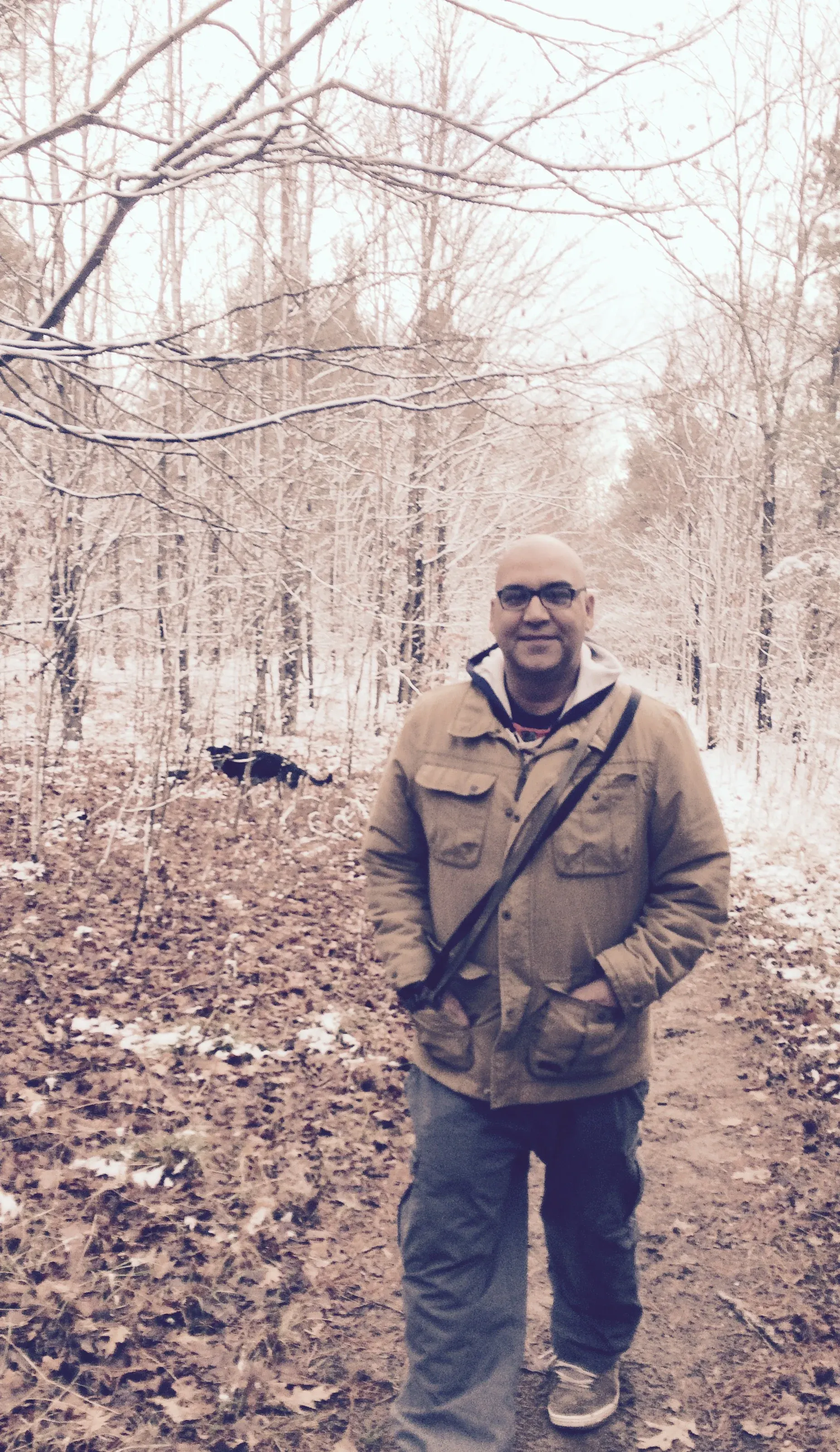
Brian Michael Barbeito is a Canadian poet and photographer. A resident of Southern Ontario, he is the author of Chalk Lines (Fowl Pox Press, 2013). His writings and photography have appeared at various venues on line and at print journals in Canada, the U.S.A., the U.K., India, and Australia. He is currently at work on an ongoing visual and written narrative documenting nature walking through the changing seasons and scenery of regional forests and fields.
Be sure to check out Brian Michael Barbeito's photography in Issue One of Orson's Review.