
*This blog post was read first by subscribers of the Orson's Reading Group. Make sure you're the first to hear of everything we have to offer by signing up today.
When you stop and think about it, names are kind of weird, right? Weird in the way that the majority of people have no say in what name they're given, yet those same people approach their name with monogamy, sticking with it in sickness and in health until death do they part. I repeat: that's weird, right, when it seems like such an easy change -- just letters, just one word?
The fact that a record 85,000 people in the U.K. legally changed their names in 2017 leads us to believe that we're not alone in wondering.
Let's adjust our focus here for a second, to just how common it is for businesses to change names. I can't track down a concrete number from a reputable source, but I can say that there are dozens of articles that walk the change-seeker through each step of the process. Which leads me to believe that it happens often, and, for some businesses, on multiple occasions.
Now, let's adjust our focus one more time, and take a look at Orson. Because, while the monogamous nature of given names can certainly be viewed as odd, I find the origins of given names to be fascinating, and even heartfelt. Hopefully, you feel the same way.
Let's start here:
They say successful businesses start off as simple solutions to universal problems. In the early months of 2016 -- due to the demands of a full-time job, I was losing ground in the chase of my dream of being a writer. More specifically, I was struggling to find time to write in the way I would've liked: thoughtfully, patiently, unfazed by the clock. They aren't uncommon hurdles writers of today face. Because they aren't uncommon hurdles, and because I know there to be plenty of ridiculous obstacles for writers to generally overcome, I knew that I wasn't alone in my frustration, sadness, and shame of the chase.
But I was alone. Due to many factors, I fell out of touch with the writing community I once had -- a community that lent the feedback and support necessary to improve, and to hold yourself accountable for improving.
"...many, many people would steer you far away from wanting a name that could be confused with something else."
At that point, I'd known for some time that writing wasn't the only thing I could offer to the book publishing industry. And considering the full-time job I mentioned earlier meant that I was spending 40 hours per week in the digital marketing world, I'd begun developing skills easily applicable to new, independent ventures.
So the wheels started turning. And, at least in my mind, the problems started to actually look like they could be solved by spearheading an independent publishing company: 1) I could write the way I wanted to -- if not immediately, this would absolutely be an accelerated path toward that goal, 2) I could begin creating a new writing community, one that helped me improve, yes, but one that also extended a rarely seen or felt olive branch to writers in similar boats, and 3) by keeping the publishing company approachable to writers and readers alike, I could do my part in chipping away at the notion that literature is, and has to be, pretentious.
Paring that down: 1) Independent. 2) Community. 3) Approachable. How to communicate that through a name?
Because independent mostly just came with the territory of doing it on my own, I mulled over the "Community" and "Approachable" aspects, and held tight to the desire of having this publishing company easily confused with a bar. For example, "Oh yeah, meet me at ------," or, "Did you see what's new over at -----?" Which I admit may sound silly at first, as many, many people would steer you far away from wanting a name that could be confused with something else.
But read over the following competitor names and consider whether or not they can be placed in those sentences: Dzanc Books; Europa Edition; Callisto Media. So it made sense to me -- and maybe it still only does make sense to me -- to have the publishing company adopt a first name. Like "Bob's" but not "Bob's". "Tom's" but not "Tom's". You get it.
But I knew that just a name that sounds like it could be a bar wouldn't be enough. It wouldn't provide stopping power, or lasting power. What could, I thought, was if the name represented a fictional character. Not a monster, no, and not a human either. A recognizable creature, a cute creature, but also a somewhat otherworldly creature. Like a bear.
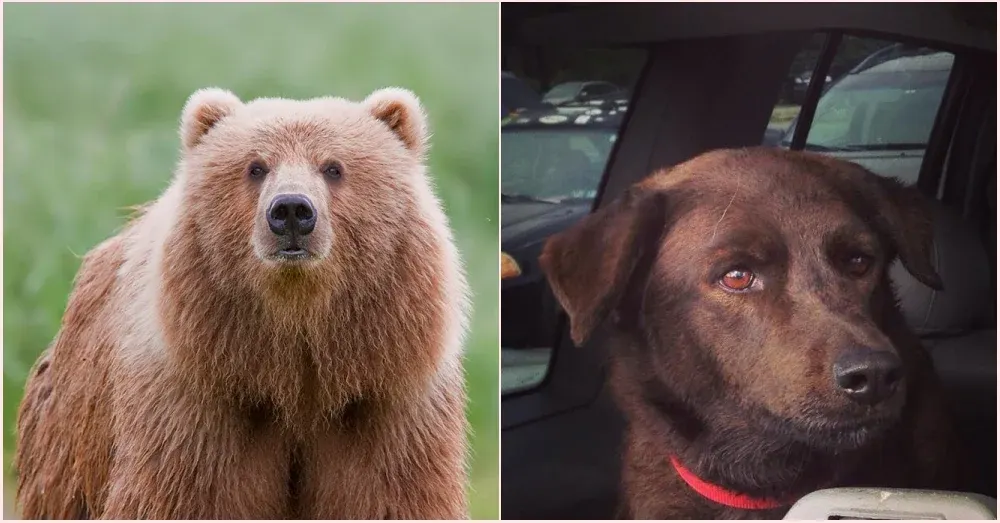
This was also helped along by two things: 1) bears have been my favorite animals for years [partially due to these facts: my name's Garrett; an informal nickname for Garrett is Gare; I was called Gare Bear for a long, long time], and 2) at the time, my girlfriend and I were parents to a lovely chocolate lab mix that looked so much like a grizzly that we called her "Bear" more often than her actual name. In retrospect, I like to think that, because she was 11 then and time certainly wasn't stopping -- we sadly had to put her down recently, and continue to miss her every day -- I opted to go the bear route due in some part to memorializing her in a way that wouldn't be overly weird [i.e. naming it directly after her, or having the logo be her likeness].
I mean, the resemblance is uncanny, right?
Next was giving our fictional bear a name. As stated earlier, neither "Bob" nor "Tom" were high on my list, but I wanted something sticky. Catchy's good and all, but I didn't want this to be a flash in the pan. Sticky, on the other hand, can last.
So I started kicking around some ideas. And the fact that I can't find those initial name ideas anywhere leads me to believe that they were absolute garbage. Not even worth hanging onto just to five years from now see how far I've moved the ball. But, I do remember searching for names that, in some way or another, meant "bear": there was Arthur (Celtic for "bear-man"), and there was Bernard (English for "bold as a bear"), and there was Ursula (Latin for "she-bear").
And then I came upon Orson.
ORSON
Gender: M
Origin of Orson: Latin and English
Meaning of Orson: From an English surname which was originally a nickname meaning "bear cub", from a diminutive of Norman French ors "bear", ultimately from Latin ursus.
I'd be lying if I said I'd been immediately and completely drawn to the name Orson. It took some time. Took some grappling, some going back and forth, specifically between Orson and Ursula. While "Artie's" or "Bernie's" would certainly have been approachable, I ruled out Arthur and Bernard because of their familiarity; they're anything but otherworldly, and could actually have a negative effect on business because of their familiarity -- seriously, folks could have many Arthurs in their lives, or Bernards, and they could hate each and every one of them, which could carry over into how they view this publishing company. With Orson (Orson Welles) and Ursula (Ursula Andress, Ursula K. Le Guin), I found there to be less of that risk involved.
So, Orson and Ursula. Orson vs. Ursula. The answer here, I thought, was pretty simple: speed. Ursula simply has more syllables than Orson, and would seem less approachable, and therefore less sticky.
Tack on what it is the company would do (publishing), and we had our name: Orson's Publishing. A strong name, I thought (and still think). A carefully-chosen name. Perfect? That isn't for me to say. I can say that so far the response from writers and readers alike has been wonderful. And I can say that Orson's Publishing has produced ambitious work by talented people, and will continue to do so for as long as it can.