
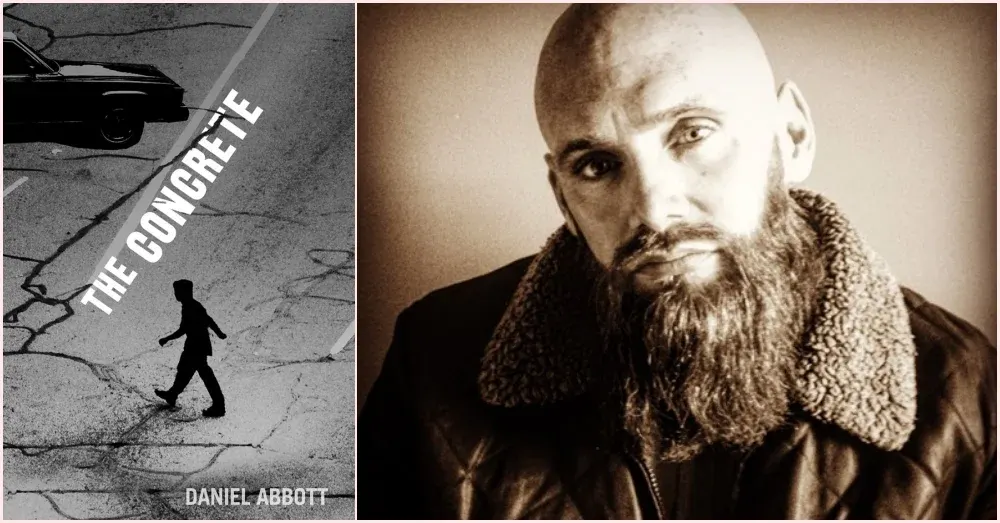
Recently, we had the pleasure of reviewing Daniel Abbott's debut novel, The Concrete. Daniel was also kind enough to sit down and talk shop with us, the back and forth of which you'll find below.
Enjoy, check out the review, and be sure to keep up with Daniel's latest, over on Twitter.
*This interview involves Orson's Publishing (OP) and Daniel Abbott (DA).
OP: What’s your writing process like? What about your revision process?
DA: First drafts are like an archaeological dig. I have a bunch of bones and I know they form something, but I’m not sure at this point in the process what it is. The writing is slow-going in this stage and my first drafts lack a lot of interiority and description. I get very little enjoyment out of first drafts. I brood too much and I’m unpleasant to be around. I love revising though: I love adding muscle to the skeleton, I love painting the details. I try to maintain a healthy reading/writing balance as a way of life, but whenever I hit my stride writing, whether it’s a day, or a week, or a month I indulge it. I write until I’m emptied. Then I’ll read aggressively until I get the urge to write again.
OP: What’s your first step in outlining a new project?
DA: My version of an outline usually comes after weeks of brooding. My writing is moment based: Things I’ve experienced, or witnessed…things that have stuck with me over the years. It could be anything: I’m at a red light and I see the woman idled next to me crying. I’m on a city bus and I see a man take off his shoes and socks and start clipping his toenails. Anything. I have all these moments simmering, always, and some of them fit into a particular project, some of them don’t. The loud ones tend to come forward and the quiet ones tend to shape it. So, I guess my first step in outlining happens when I have enough cohesive moments to start assembling some skeleton of a narrative.
OP: What made you decide to pursue writing? Can it be whittled down to a moment? A person?
DA: In 2010, six months after being downsized from my job, my six children and I moved into my best friend’s basement. I remember one night I was pacing, my sons Kevin and Simeon were sleeping on the couch, my daughters, Keyaira, Van, Andi, and Lauren were sleeping on a king-sized mattress that sat atop a box spring with no frame. I’ll never forget how I felt in that moment; coming to the realization that my life was my fault, accepting the blame and that to undo the damage would take some time. I faced hopelessness, depression—my failures heightened by my situation. I began blogging rants in the nature of spoken word poetry, with no real structure or form, but they were well-received. It was therapeutic to vent and be understood, but I felt called to do more. To write more than a few pages of chaotic reflections. I needed more space.
I enrolled in the Creative Writing program at Grand Valley State University, still without a clear vision of what I wanted to do with a degree in writing. I think it was my second semester at GVSU that you and I sat in Sean Prentiss’ Intermediate Creative Nonfiction class together—I listened to Sean talk about what it meant to be a writer, how hard you had to work, and something about his words and the passion behind them, sparked something in me and I just knew I was on the path I was supposed to be on.
OP: What do you want most out of your literary community?
DA: Reciprocity. I believe in promoting the work of my colleagues. As you know, It is difficult to make money writing creatively. There are hundreds of MFA programs throughout the country/world graduating thousands of writers each year.The competition for lit journal publications, agents, and publishing deals is fierce. We do not need to claw each other down to succeed. What I love most about writing is that there is no ceiling. Effort guarantees improvement. If you write and read with passion and purpose at some point will be heard. I think that varies, of course, based on talent, effort, and factors you cannot control like luck, or life experience—does your writing come from a place that attracts readers, etc. I try my best to be a good literary citizen. I let art be art, because regardless of my own tastes, someone will appreciate it. I hope that my colleagues give me the same support.
OP: Do you think other genres can achieve what fiction can achieve?
DA: Absolutely, but I think it’s subjected to the reader. I’m drawn to fiction as a reader because of language and story, or specifically, character in story. Creative Nonfiction can achieve the same effect for me as a reader. The creative nonfiction I enjoy reads like fiction. Townie by Andre Dubus III and Michael Chabon’s Moonglow (which is technically a novel) come to mind. And one of your favorites, Tim O’Brien’s The Things They Carried. Poetry can do more with language than either fiction or nonfiction, but it is limited in its storytelling ability, I think. With poetry I think it can tell a story, and develop a character, but what makes great poetry (for my taste) is descriptive language that engages the senses. On the flip side, if you get too showy with language in fiction or CNF it can get in the way of the story—draw too much attention to itself.
OP: As your writing career progresses, do you think The Concrete will always be close to your heart?
DA: To write a novel is to give birth. And oh what labor pains The Concrete gave me. Ten drafts over the course of three and a half years. I probably deleted over one thousand pages to get the 312 that made the final draft. It is the realization of a lot of hard work and learning. A lot of really early mornings and long days of writing. It is a first child. When I entered the MFA program at VCFA my biggest asset as a writer was at the sentence level. I leaned heavily on that strength and ultimately my prose was getting in the way of my story—I was guilty of what I mentioned above, of crafting sentences that were drawing too much attention. I still have a ton of growth in me and I hope each book I write is a growing process, but writing The Concrete, and being in my MFA program while I wrote it, was me coming to my own as a writer, and for that I will always be grateful. It will always make The Concrete special.
OP: What about The Concrete was a challenge for you to write?
DA: The multiple POVs were difficult at times to manage—keeping the entire narrative intact, while keeping the threads of separate narratives strong on their own—that induced much pacing and markering of the whiteboard. Also, deciding how to tell the story once I realized the novel needed so many different POVs. To create a rich narrative while writing in a fragmented style required me to constantly carry the entire story with me when I wrote the separate threads. When every piece forms part of a larger picture, flawless consistency is necessary, which requires a ton of concentration. I think ultimately, though, the most difficult part for me was spending so much time in the world of The Concrete. I am a total-immersion writer. I slip into my scenes, into the skin of my characters, and I’m looking at the world through their eyes. It took me three and a half years to write the book. Besides a few couple-week breaks I was writing between 30-60 hours per week. So I spent a ton of time in the skin of prostitutes, drug dealers, pornographers, etc. It wears on you. You feel the darkness.
OP: The Concrete is your debut novel. You have an agent for the first time. Have you experienced anything like it before?
DA: This entire experience: writing a book, querying agents, being on submission with publishers has been a wild ride. There are these long periods of waiting followed by short-lived victories followed by more long periods of waiting. As a debut novelist, only knowing what to expect theoretically, or based on information my mentors have given me, or the research I have done, man…this process has been hard! My agent, Sarah Levitt of Aevitas Creative Management has been awesome. She is always available to answer questions and has been great about explaining the process, what steps we’re taking and why, and giving a timeframe for what we’re doing. I’ve learned in this process not to get too high when the victories come and to use those long periods of waiting to busy myself with work, with writing, with trying to figure out how to be in the room on social media (which has been a challenge as well) and just enjoy the ride as much as I can, without being all like, “Are we there yet?”
OP: One thing I love about The Concrete is its diverse cast of characters. There are men. There are women. Kids. Adults. Bachelors and bachelorettes. Husbands and wives. There’s strength. There’s weakness. And there are dreams. I guess I’m curious: when did The Concrete become an ensemble? Is that how you always envisioned it?
DA: Absolutely not! And for the record I wouldn’t wish twelve points of view on ANY writer. It’s maddening! The ensemble happened because it was necessary. This was going to be the story of Isaac Page overcoming the death of his mentor, through basketball and music, growing up in foster care. I finished a really skeletal first draft and there were just too many questions, too much back story that needed to be told. I didn’t want to bog down the narrative with back story and this thing just kind of spiraled on me, became a totally different beast. I ended up telling a lot of stories and bringing them together. In the end the book became what it was supposed to be—a story of a neighborhood and the people in it, and how a community can become entangled.
OP: When reading The Concrete, I pick up on some Junot Díaz flavor, and on some Colum McCann, as well as — and this may be weird, just hear me out — a bit of Spike Lee’s Do the Right Thing. At the same time, The Concrete reads and feels entirely like its own thing. I’ll transition into my question now: as you know, writers are told to read many books, to read many authors, and to read often. Taking in all of those different voices, and being influenced in some way or another by all of those voices, how is it that you’ve been able to craft your very own style?
DA: I’m not surprised you mention Junot Díaz and Colum McCann. The year between attending the undergraduate writing program at Grand Valley State University and attending the low-res MFA program at the Vermont College of Fine Arts, where I began work on The Concrete, I was tearing through their books. And really I’m not terribly surprised you mention Spike Lee either. A lot of people have described the style of The Concrete as cinematic. It bounces from point of view to another point of view at a pretty quick pace and the scenes, for the most part, tend to leave you hanging a bit. The camera moves. It’s cool that you read The Concrete as its own thing, though. I share the belief that writers need to read. There’s a line in the book that Mae Carter uses: “Reading is a writer’s weight room.” That line captures exactly how I feel about it. We grow as writers by reading writers who are better than us, or who use a different style, who employ a different world view. As far as crafting my own style: I think we cannot help but be influenced by reading writers we admire. It’s not a coincidence that you picked up on Junot Díaz and Colum McCann—they are two of my favorites. I think we take our natural abilities, and we build on them. Reading great writers such as Junot Díaz and Column McCann (and many MANY others) has helped me build on my own natural abilities and become a more well-rounded writer.
OP: If you could have a drink with one writer, alive or dead, what would the drink be, and who would it be?
DA: I’d love to have coffee with Toni Morrison. First, I admire her talent and her work. The way she deals with sexuality and dark situations with such beautiful, BEAUTIFUL sentence level writing and language that just kind of sings to the senses—it's something I strive for in my own work. Plus she came to writing later in life (I believe in her 30s) like I did, and as a single parent, like I was, which makes our paths similar and relatable. I think that would be a great conversation to have.
OP: How important of a role do you think books will play in the future?
DA: I remember when the Ebook arrived, and the Kindle, and all these different electronic ways to read literature, people were screaming doomsday for books. But I think there is a large population of nerds like me, people who like to be surrounded physically by books, who like the look of them, the smell of them, and who will keep the publishing industry thriving.
OP: What does a revolutionary book look like today?
DA: A revolutionary book tackles an old problem from a new point of view, or introduces a new problem in a thought provoking way. Both ways inspire change, a conversation.
OP: Give ten words of advice for aspiring writers.
DA: Do not romanticize the craft of writing. It is work.
OP: Where can readers find your work?
DA: The Concrete is currently available for preorder at Amazon and Barnes & Noble, and many other places. If you check out my Goodreads Author page there is a listing there.
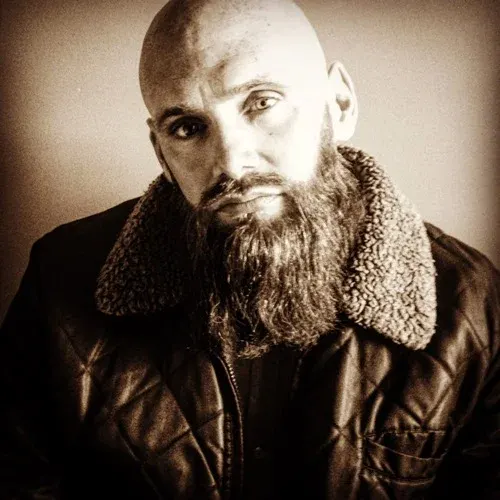
Daniel Abbott is a novelist and short story writer from Grand Rapids, Michigan. He earned a BA in Writing from Grand Valley State University and an MFA in Fiction from the Vermont College of Fine Arts. Daniel’s short fiction has appeared in the Noctua Review, Ginosko Literary Journal, and Owen Wister Review.
Daniel's debut novel The Concrete is now available for preorder. Be sure to check out our review of The Concrete, and to follow Daniel on Twitter.