
We're honored to feature new poetry by Sean Prentiss in Issue Two of Orson's Review, which will be released on March 19th, 2019. Sean is the award-winning author of Finding Abbey: A Search for Edward Abbey and His Hidden Grave, and is the series editor for the Bloomsbury Publishing Writers Guide Series.
We're very fortunate for the time Sean took to sit down and chat with us about his journey as a writer.
*The following interview involves Orson's Publishing (OP) and Sean Prentiss (SP).
OP: How did your journey with the written word begin?
SP: My freshman year in college, my mother asked me to keep a journal. As a good son, I listened to her. So I wrote in it all during college, where I studied no literature or creative writing (I earned a business degree.). And I kept writing and writing. Finally, a decade later, a friend asked me to turn one of my journal entries into a magazine article, which I did. Shockingly, a magazine immediately accepted it and published it and paid me for it, and that began my life as a writer. Completely accidental.
OP: Is being a poet your primary occupation?
SP: Yes, I occupy so much of my time thinking about the poetry of the world around me. I live a moment and dream of how to express it not in images but words on the page. Now, do I earn much money from poetry? No. But money has nothing to do with occupation or vocation or profession, at least to me. Once I collect enough money to survive (through being a professor, a job I cherish), I can spend the rest of my time studying the world around me.
OP: What about these poems are you most proud?
SP: I am most proud that these poems share the story of the great men and women (back then they were young men and women) who made up my trail crew. Those crewmembers changed my life and taught me so much about leadership and passion and dedication and community. So it is an honor to attempt to tell their stories in poems. I hope they feel that I have captured some image of them. And I thank them for following me, back then a new leader, into the woods for weeks on end. They are my sons and daughters, my brothers and sisters.
OP: Tell us about your writing process. Do you approach all pieces of writing in the same way?
SP: Overall, yes. I’m detail oriented. So I often come up with an idea first and come up with a shape (genre: poetry, prose, drama) and a veracity (truth or fiction). And then I try to imagine what the central question might be. Then I write a mediocre first draft, revise a better second draft, and continue on that process.
I also try to see writing (and all art) as similar to plumbing or carpentry or cooking or logging. It is all work. No trees will fall unless I start up my chainsaw. And no poems will be written unless I lift my pen or start my computer. Further, no art is better than another. So my poems are no more magical than a meal cooked by a great chef or a tree dropped in a beautiful manner or a chair built in a beautiful way. To me, the world is filled with artists and craftspeople, and they are our writers, our painters, our electricians, our custodians, our stay-at-home mothers, and the list goes on.
What this means is that it is my job to honor being a poet by getting to work, by putting in the time, by sitting in the seat, by working just like every other person works. And then to love what I do.
OP: As a child, what did you want to be when you grew up? How has that impacted your writing?
SP: Strangely, I never dreamed of being anything. I only remember being afraid of the garbage man. I thought he might steal me and toss me into his truck. Besides that, I just wanted to wrestle and read and wander in the woods or play in my river. Even in college, I chose a degree because I needed to. It wasn’t until I got a job building trails that my life started becoming clearer. And then teaching. And along with teaching, writing. And then, accidentally, I had it all: environment, teaching, writing. That is now all I long to do, something with those three things.
OP: Tell us about the biggest sacrifice you’ve made while pursuing writing.
SP: Right now, I am typing this, while my beautiful daughter (nearly seventeen-months-old) plays with my wife. I hear them giggling, and I hear little Winter Eve crying. Every moment I spend writing is a moment away from her. But, the great thing is that I can stop writing right now and go tickle my daughter. I’ll be back in fifteen minutes.
OP: How many books do you read in a year?
SP: And I am back from my daughter. This answer has two questions. Before having a daughter, I might read three to five books a semester and another five to fifteen books a summer. Maybe a third of these would be for pleasure and two thirds for research. Now, with a daughter, I read maybe two or three books a semester, if lucky. Summers, I read five or more books with many of them being for research. But as Winter Eve gets older, I’m able to find a bit more time to read each day, which is a nice joy. Right now I am reading Through a Long Absence, a beautiful book by Joy Passanante about her father’s time in World War II.
OP: Do you attend poetry readings? If so, tell us about the best one you’ve ever attended -- what made it so good?
SP: I do! I am lucky to live in Vermont where we have a writer on every corner and an independent bookstore in just about every town. My local bookstore is The Galaxy Bookstore in Hardwick, Vermont, our perfect bookstore! They hosted a reading there that included Todd Davis, his son Noah Davis (both of whom happen to be visiting me tonight), Joe Wilkins, and me. What I loved about this, along with listening to those three read and it being Noah’s first major reading, was that we did a round robin where one of us would read and then someone else would stand up and say, “When I was listening to that poem, it made me think of …” So the reading was a conversation by some of my favorite poets. And I was able to hear their poems talk with each other. It was a beautiful night to listen to some amazing poets.
OP: What do you want most out of your literary community?
SP: Community. I just love talking about writing and ideas. So I love meeting up and talking about writing and the environment and teaching and life. And that is what I’ll do tonight when Todd Davis and Noah Davis show up. We’ll talk about these lives and writing lives of ours.
OP: Do you believe that an MFA is crucial to success as a writer today?
SP: I am not sure it is critical to all writers. But it was critical for me. My MFA program at the University of Idaho saved me years and years of time. I was a self-taught writer and the process was slow and laborious and filled with wasted time. I learned more in one year at my MFA than I did in a decade of teaching myself to write. So working with Mary Clearman Blew, Joy Passanante, and Kim Barnes was the best learning I’ve done in my life. And anything I publish is a direct result of their teachings.
OP: What do you cross your fingers for as a writer?
SP: Very little. This life is pretty perfect. I have a beautiful wife, Sarah Eve, a beautiful daughter, Winter Eve, a wonderful dog, a perfect home on a small lake, a few books in print, a few more books coming out, more ideas in the works. I don’t need to cross my fingers for anything. I have it all. And I am thankful.
OP: Where do you see your journey with the written word going?
SP: The same place it’s always gone. Forward into the next idea, which seems to always be revolving around the ideas of “home.” So I’ll keep writing and thinking about home in all its permutations.
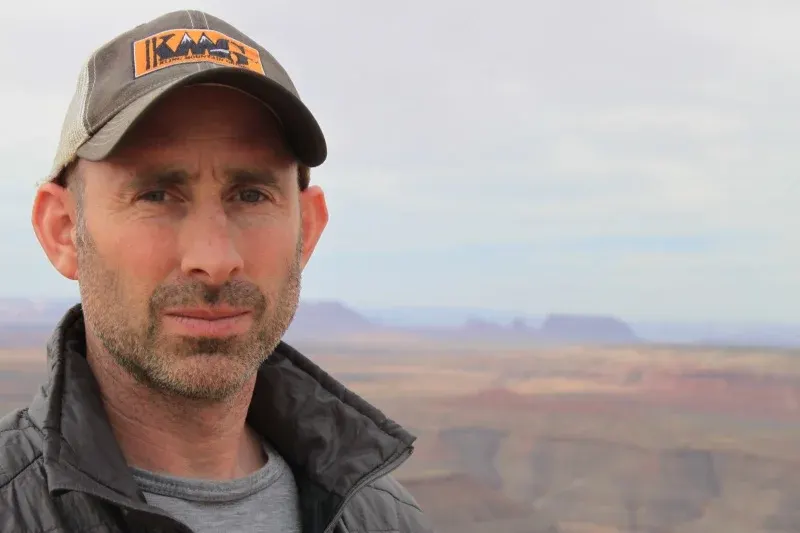
Sean Prentiss is the award-winning author of Finding Abbey: a Search for Edward Abbey and His Hidden Desert Grave, a memoir about Edward Abbey and the search for home. Finding Abbey won the 2015 National Outdoor Book Award for History/Biography, the Utah Book Award for Nonfiction, and the New Mexico-Arizona Book Award for Biography. It was also a Vermont Book Award and Colorado Book Award finalist.
Prentiss is the series editor for the Bloomsbury Publishing Writers Guide Series. This textbook line includes a variety of forthcoming textbooks all focused around creative writing. Two books, Environmental and Nature Writing: A Craft Guide and Anthology (written by Prentiss) and Poetry: A Craft Guide and Anthology are currently in print and three books are under contract, including Prentiss’s Advanced Creative Nonfiction.
Prentiss is also the co-editor of The Far Edges of the Fourth Genre: Explorations in Creative Nonfiction (Michigan State University Press), a creative nonfiction craft anthology, and the co-editor of the forthcoming book, The Science of Story: The Brain Behind Creative Nonfiction (Bloomsbury Press).
He and his family live on a small lake in northern Vermont, and he serves as an associate professor at Norwich University and is a faculty member in the M.F.A. Writing and Publishing program at Vermont College of Fine Arts.
Be sure to check out Sean’s latest poetry in Issue Two of Orson’s Review.