
We're honored to feature new poetry by DS Maolalai in Issue Two of Orson's Review. Issue Two of Orson's Review will be released on March 19th, 2019.
We're also very fortunate for the time DS took to sit down and chat with us about his journey as a poet.
*The following interview involves Orson's Publishing (OP) and DS Maolalai (DM).
OP: How did your journey with the written word begin?
DM: I was lucky enough to have a librarian for a father who was willing to abuse his power and disregard overdue fines, so growing up books were a cheap form of entertainment that was always available - I think the writing probably grew out of that. I think that my first attempts at seriously writing began before I was even a teenager - I'd plot out these fantasy novels, mostly in the vein of imagining "I am a sexy pirate with a scar who has adventures". To be honest, the only difference that 20 years has given it is that I've accepted I don't have the discipline for a whole story, and the "sexy pirate" I imagine has become a "cool poet" instead.
OP: Is being a poet your primary occupation?
DM: Is anyone lucky enough to answer yes to this anymore? I work maintenance dispatch. I think it helps to have another occupation - I can't imagine how dull my writing would be if I wasn't forced to get out and talk to people every day.
OP: What about these poems are you most proud?
DM: I'm a big fan of the imagery in "Checkers" - I think when you're layering metaphors like that it's very easy to get caught up in them and lose focus on what the poem is actually about. I'm glad I managed for once to control myself when I was writing that one. With "The pipework", I'm mostly proud of having somehow pulled a poem out of the most disgusting aspect of the apartment I was living in when I wrote it - it makes thin walls and a bad drainage system feel a little more worthwhile.
OP: Tell us about your writing process. Do you approach all pieces of writing in the same way?
DM: Generally speaking, I open a bottle of wine about twice a week after work. When I wake up the next morning there are five or six poems on my laptop - maybe if I'm lucky even one or two good ones. I'm suspicious of anyone who romanticizes drunken writing as a way to quality - the fear of becoming "Guy in Your MFA" is very real - but it seems to generally work for me.
OP: As a child, what did you want to be when you grew up? How has that impacted your writing?
DM: Until literally the day before my college application was due I'd been planning on a career in accountancy. Then at the last minute I panicked at the thought of a life of spreadsheets coming like snow, scrapped the entire thing and applied for an English Degree at Trinity College. I've never been much of a one for the long-term, and I can see that dodging that was probably what got me where I am.
OP: Tell us about the biggest sacrifice you’ve made while pursuing writing.
DM: I always write with the assumption that the subject of a poem won't read it, and that hasn't always been the case. I know some of my friends have gotten annoyed at me for being, shall we say, a little too honest, and I've gotten some nasty messages from ex-girlfriends who didn't like the way they were portrayed.
OP: How many books do you read in a year?
DM: Out of an unfortunate habit of spending time in used book stores I buy maybe three books a week, but I rarely get more than half-way through. Of the books I finish, probably only in the range of 12-15? But taking into account those I leaf through and then lose under sofa unread it would likely be in the 50s or 60s.
OP: Do you attend poetry readings? If so, tell us about the best one you’ve ever attended -- what made it so good?
DM: I'm not much of a one for live performance. I saw Tara-Michelle Ziniuk read at a festival in Toronto - that was a good one. But she's a gifted performer. I think most people that write poetry do it because it's a solitary art - those people don't tend to be crowd pleasers. I myself hate reading live. I lose all confidence in my words.
OP: What do you want most out of your literary community?
DM: I'd like for it to become less stratified - to talk out of school a little, Dublin's literary scene certainly doesn't tend toward the democratic. Newcomers tend to spend their time kicking against it, until suddenly they're accepted for making their kicks interesting, at which point they'll close ranks against those who were outside with them, also kicking to get in. More acceptance of newer writers and less traditionally educated voices is something the Dublin community at least needs to strive for - though of course, I say that as one of those outsiders looking for validation.
OP: Do you believe that an MFA is crucial to success as a writer today?
DM: God I hope not.
OP: What do you cross your fingers for as a writer?
DM: I mostly hope that people don't see through me.
OP: Where do you see your journey with the written word going?
DM: I would like to stay working with indie publishers - my first collection is basically invisible already, and in the new year I have a book coming out with a small publisher in Dublin, Turas Press. If I have any picture of what the future holds, it's a collection of one-off rarities but no major success. I can't see myself making it as a professional poet full-time - certainly I don't think anyone could justify spending grant-money on me - but the idea of being a minor footnote, known to people who know their shit but not to anyone else, is perversely appealing to me.
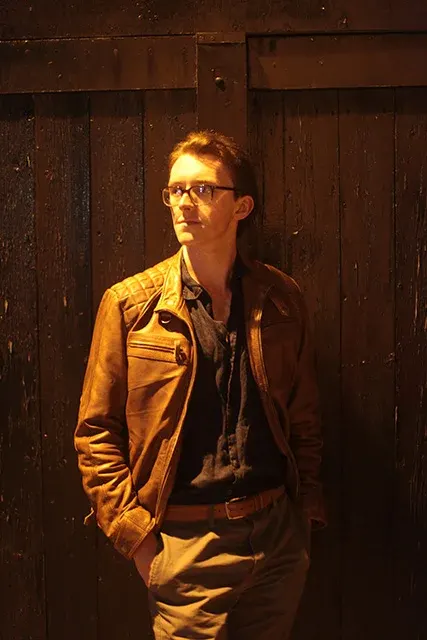
DS Maolalai is a poet from Ireland who has been writing and publishing poetry for almost 10 years. His first collection, Love is Breaking Plates in the Garden, was published in 2016 by the Encircle Press, and he has a second collection forthcoming from Turas Press in 2019. He has been nominated for Best of the Web and twice for the Pushcart Prize.
Be sure to check out DS Maolalai’s latest poetry in Issue Two of Orson’s Review.