
We're honored to feature new fiction by Scott Navicky in Issue Three of Orson's Review. Issue Three of Orson's Review was published on September 24th, 2019.
We're also very fortunate for the time Scott took to chat with us about the writer’s journey. Check out the discussion below.
*The following interview involves Orson's Publishing (OP) and Scott Navicky (SN).
OP: How did your journey with the written word begin?
SN: As a magpiethinker, I love to magpie other people’s quotes. Here’s a great one from the poet E. A. Robinson: Early in life, I realized that I was doomed, or elected, or sentenced for life to writing… I kept the grisly secret to myself.
OP: Is fiction writing your primary occupation?
SN: YES!
Wait… do you mean do I actually make enough money from my writing to pay bills? In that case: NO!
I also lecture. This semester I’m teaching a class that begins as a history of western art from the Paleolithic Era to the Quattrocento and slowly transforms into a rugby appreciation class. (I can pretty much turn any art history lecture into a discussion of rugby.)
OP: What about this story are you most proud?
SN: A guiding principle of my work is the question: “What forbids us to tell the truth, laughing?” (Source: Horace’s Satires.) I’m proud of how this story intertwines the truth (real people, real places, and real events) and humorous fiction. I’m also proud that the piece includes the chorus from one of my favorite Felice Brothers songs. (Hint: it involves chickens!)
OP: Tell us about your writing process. Do you approach all pieces of writing in the same way?
SN: Yes, my approach never wavers. I work all day & think about writing all night. In rugby, this is called emptying the tank. It’s like sledding. When done correctly, writing should feel exhilarating. When I run out of MOMENTUM, I trudge back to where I started, compose myself, and start zoomzoomzooming again.
OP: As a child, what did you want to be when you grew up? How has that impacted your writing?
SN: I can’t remember ever wanting to be anything except a writer. As a child, when asked what I wanted to be when I grew up, I would lie and answer “a professional basketball player.” This wasn’t true, but I thought this answer was more acceptable than “a writer.”
OP: Tell us about the biggest sacrifice you’ve made while pursuing writing.
SN: Probably my personal relationships. I believe everyone around me secretly hates me because of my reluctance to get a traditional, well-paying 9-to-5 job. It’s not that I’m not employable – I’m actually quite good at soul-crushing office drudgery – it’s just that I’m a miserable, grumpy bastard when I’m not writing.
OP: How many books do you read in a year?
SN: Not many. I’m very cautious of contamination. Every night before bed, I read aloud from either Ulysses (my favorite book) or Shakespeare’s Sonnets. Not many people love the Sonnets, but I do. My love of the Sonnets features heavily in my book 3Essays on Imagereality. And now that I’ve mentioned it, I feel extremely guilty about never having read Horace’s Satires. I found that quote about telling the truth laughing in Nietzsche’s Ecce Homo: How One Becomes What One Is. (I read a ton of Nietzsche!)
OP: Do you attend readings? If so, tell us about the best one you’ve ever attended -- what made it so good?
SN: YES! Along with rugby and alcohol, readings are what I live for! While living in NYC, I attended readings almost every week. My debut novel Humboldt: Or, The Power of Positive Thinking includes a scene that takes place at a Paul Auster reading.
Probably the most memorable readings I’ve ever attended were by the poet Stanley Kunitz. He was so old and so delightful and so wonderful that he mesmerized crowds. I’ve never forgotten the story he told of how he first discovered the poet Gerald Manley Hopkins (another favorite of mine). One afternoon as a child, he was in a library. A book falls from a shelf. Plonk! Hits him right on the head and falls open to the poem God’s Grandeur.
Also during a gigantic outdoor poetry festival in Bryant Park, when he finished reading the final stanza of his poem Halley’s Comet, I swear the entire city stopped breathing.
I can still hear the ghost of his voice when I read the lines:
Look for me, Father, on the roof
of the red brick building
at the foot of Green Street—
that’s where we live, you know, on the top floor.
I’m the boy in the white flannel gown
sprawled on this coarse gravel bed
searching the starry sky,
waiting for the world to end.
OP: What do you want most out of your literary community?
SN: Alcohol. No seriously, that’s about it. I don’t have much of a literary community, but I’m willing to talk books with anyone, anytime, anywhere if alcohol is involved. I’m an anythingarian literary boozehound. My new manuscript – a spatchcocking of a guidebook to Ohio and a contemporary misreading of Samuel Beckett’s Murphy – is titled A Boozehound’s Guide to Ohio (as compiled by the New Zealand Appreciation Society of Southeastern Ohio).
OP: Do you believe that an MFA is crucial to success as a writer today?
SN: Not necessarily, but you need something. An MFA is something. Of course, there are other, less expensive somethings. Being a writer who writes good books sadly isn’t something. Even with social media, it’s easy to get ignored.
OP: What do you cross your fingers for as a writer?
SN: An agent. I know they exist. Hundreds of them! They’re probably out there right now: breathing, proofreading, tweeting, composing emails, eating lunch, signing deals, giving positive feedback, clipping their fingernails, nurturing talent, providing shoulders to cry on…
OP: Where do you see your journey with the written word going?
SN: Into the murky depths of a pseudonym. Once I’m finished with A Boozehound’s Guide to Ohio (as compiled by the New Zealand Appreciation Society of Southeastern Ohio), I want to create a humorous Russian-sounding pseudonym and write a book that’s both a contemporary retelling of the love triangle between Friedrich Nietzsche, Lou Salomé, & Paul Rée and a grammar guidebook. WHY? Because what forbids us to teach grammar, laughing? I’ve even got a working title: A Drunksledding Guide to Grammar.
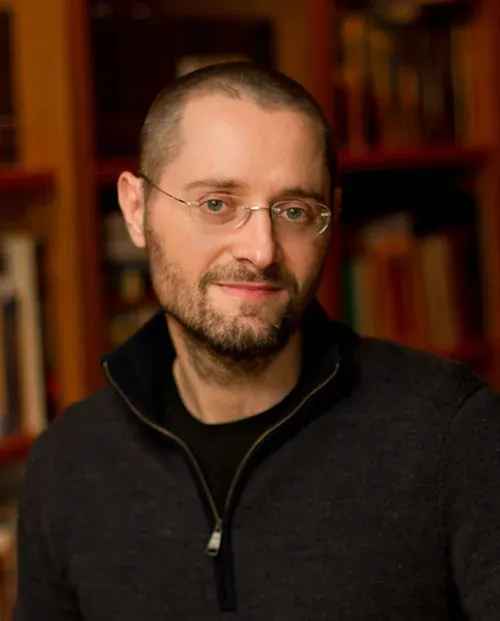
Scott Navicky is currently writing A Boozehound's Guide to Ohio (as compiled by the New Zealand Appreciation Society of Southeastern Ohio), a spatchcocking of a guidebook to Ohio and a creative misreading of Samuel Beckett's novel Murphy. His debut novel Humboldt: Or, The Power of Positive Thinking is a creative misreading of Voltaire's Candide that begins in the Midwest and his second book, 3Essays on Imagereality, is a collection of photography theory essays that also function as humorous short stories. He lives in Columbus, Ohio.
Be sure to check out Scott Navicky’s fiction in Issue Three of Orson’s Review.