

We're honored to feature Siegfried Baber's "Famous Blue Duffel Coat" in Issue One of Orson's Review. We're also very fortunate for the time Siegfried took to sit down and chat with us about his journey as a poet.
*The following interview involves Orson's Publishing (OP) and Siegfried Baber (SB).
OP: How did your journey with the written word begin?
SB: I’ve been lucky, I guess. When I was five or six, our teacher would read to the class for twenty minutes every afternoon before the end of school. And one day she began reading The Iron Man by Ted Hughes. It stuck with me for a long time. I suppose I’ve been trying to get back to that feeling, of being completely lost in my imagination, ever since. Of course, it’s not possible. But I keep on.
OP: Is being a poet your primary occupation?
SB: No -- thankfully. I work in an old bar in the city, and it’s filled with all these great characters from every walk of life; plumbers and professors; students; writers and musicians. It’s a real hidden treasure. Hasn’t changed a lick since 1776. That’s where all my ideas come from -- the people I meet, the conversations, and the quiet afternoons when the place is empty and I find myself gazing into the fireplace, or cleaning a dusty bottle of scotch.
OP: What about "Famous Blue Duffel Coat" are you most proud?
SB: Proud? I’m not sure. It’s all true though, pretty much. I still have that big blue coat, and I still wear it everywhere. The church I mention in the poem is this brilliant Catholic Church down by the river. It was hit by a bomb in the war and painstakingly restored. I often drop by on my way around town, because it‘s always empty, except for this sweet old Italian lady praying in the front row, or some heartbroken soul sitting in silence and staring at nothing in particular. I like places like that -- peaceful spots in the heart of a restless town. It’s good to take a break. It could be a church, sure, or a coffeehouse, or the public park.
OP: Tell us about your writing process. Do you approach all pieces of writing in the same way?
SB: The way I approach my work has changed so many times over the last five years. It all depends on my mood, or what I’m reading or listening to. I could be really into CK Williams and I’ll suddenly find myself writing poems with these really long meandering lines, that previously I would never have even considered. But in that moment it seems to fit. Music too, is a big influence. I’ll hear a lyric or even read a song title and in a split second a thousand ideas for a new poem will crash through my brain.
OP: As a child, what did you want to be when you grew up? How has that impacted your writing?
SB: I always wanted to be an astronaut -- but I hate flying. Can’t think of anything worse. Throughout my early childhood I was obsessed with space and interstellar travel. I l’d read books about the solar system and study the planets. Then I grew up and somehow it slowly lost its magic.
OP: Tell us about the biggest sacrifice you’ve made while pursuing writing.
SB: Where do I begin? Jobs? Money? Sanity? I’m only slightly joking -- I don’t really consider it a sacrifice. Would you ask the same question to a brain surgeon? I don’t really see it as much of a choice. In the end, it’s all worth it, as long as I can squeeze out another poem.
OP: How many books do you read in a year?
SB: Too many, probably. I have a really great library near me, so I reserve about twenty books at a time, on whatever takes my fancy at that particular moment -- currently it’s a biography of Pasolini, a big book of De Kooning prints, and a history of jazz that a friend recommended to me. My place is full of books too, mostly poetry or biography. Some music and art books. I’ve run out of space now. Eventually something’s got to give.
OP: Do you attend poetry readings? If so, tell us about the best one you’ve ever attended -- what made it so good?
SB: I used to - but not so much now. A good poetry gig is hard to find. It feels like a necessary evil, to promote yourself and your work. Most readings are dire affairs that go on way too long. Ten minutes is plenty. However, I’ve been lucky to see a few good poets - my friend Martin Malone is a superb poet and I could listen to him reading for hours. Some have the knack, others don’t. I was listening to a recording of Gregory Corso a few weeks ago. He was totally shambolic and unprepared (he stopped halfway through his poems to talk about his friends, to chat to the audience, and would sometimes quit a poem if he became tired of it) but it was totally fascinating. I loved it.
OP: What do you want most out of your literary community?
SB: To be left alone. In my town, there is no real literary community. We all secretly despise each other.
OP: Do you believe that an MFA is crucial to success as a writer today?
SB: Nope. The only crucial thing is to read and read and read. That’s it. You can’t do anything, write anything, without reading a hell of a lot of books first.
OP: What do you cross your fingers for as a writer?
SB: Immortality -- or just one half-decent poem.
OP: Where do you see your journey with the written word going?
SB: Wherever it feels like going. I only pretend to be in control.
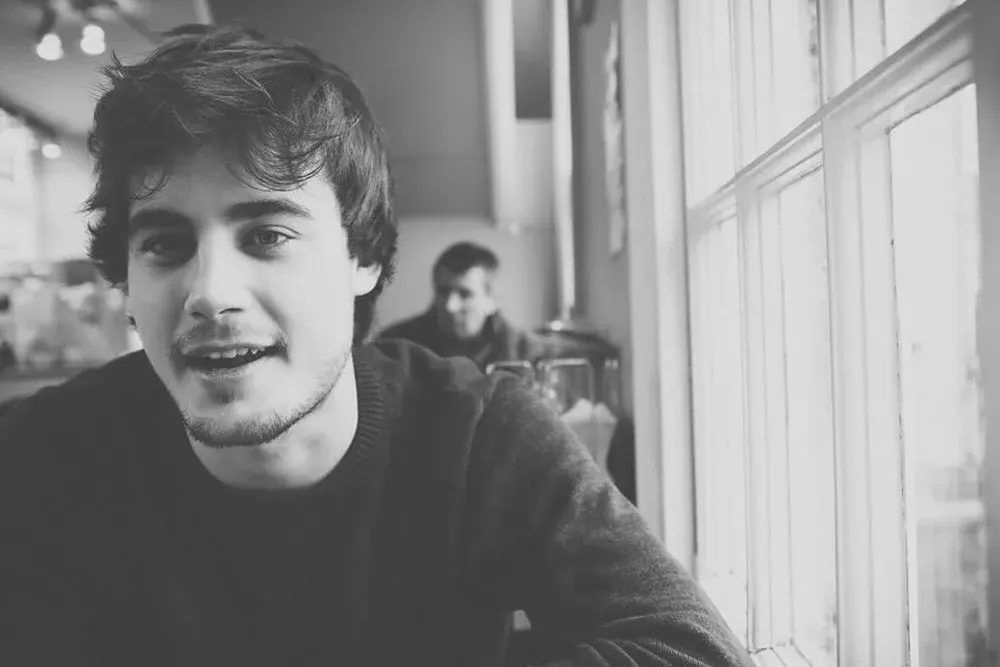
Siegfried Baber was born in Barnstaple, Devon, England in 1989 and his poetry has featured in a variety of publications including Under The Radar, The Interpreter’s House, Butcher’s Dog Magazine; online with The Compass Magazine, Ink, Sweat and Tears, Poetry Spotlight, Poems In Which; and as part of the Bath Literature Festival.
Siegfried's debut pamphlet When Love Came To The Cartoon Kid is published by Telltale Press, with its title poem nominated for the 2015 Forward Prize for Best Single Poem.
Be sure to check out Siegfried Baber's "Famous Blue Duffel Coat" in Issue One of Orson's Review.