
We're honored to feature "Variations" by Mary Lynn Reed in Issue One of Orson's Review. We're also very fortunate for the time she took to sit down and chat with us about his journey as a writer.
*The following interview involves Orson's Publishing (OP) and Mary Lynn Reed (MLR).
OP: How did your journey with the written word begin?
MLR: I've been drawn to writing in one form or another since I was a child. Over the years, I dabbled in every possible form (poetry, stage plays, screenplays, novels, stories) but I started getting serious about fiction writing around thirteen years ago. That's when I began workshopping my stories and submitting them for publication. I'm not sure there is anything spectacular to the 'beginning' of my writing journey. The compulsion to put words to paper has always been there, gnawing at me, whether I was actively writing or not.
OP: Is fiction writing your only occupation?
MLR: No. My skills and experience in mathematics and leadership pay the bills (and hopefully enhance my fiction writing, occasionally, too.)
OP: What about "Variations" are you most proud?
MLR: I aspire to be the kind of writer who is constantly observing the world around me and finding inspiration for new stories, but honestly, it rarely happens. "Variations" is an exception. This story was born from a real exchange I observed one summer afternoon at my local drugstore. There were no condoms and no Calculus of Variations textbook in the true scene but I was inspired watching a bright young cashier trying his best to explain the arithmetic of sale prices to a reluctant customer. So, I'm proud that I was able to turn that exchange into "Variations," a piece that I hope conveys a bit of the wonder I witnessed that day.
OP: Tell us about your writing process. Do you approach all pieces of writing in the same way?
MLR: I don't have anything that resembles a consistent writing process. I write when I'm inspired by something, usually an emotion that has stirred in me, from a memory or a fresh new anxiety, or a hope or a wish or, occasionally, a nightmare. And sometimes I write when I feel like it's been too long and I just need to be writing again. I used to think that writing prompts weren't effective for me but recently I've found them more useful, and I'm happy to take help from things like prompts, especially when I've been through a writing dry spell.
OP: As a child, what did you want to be when you grew up? How has that impacted your writing?
MLR: I spent a lot of years of my childhood thinking I wanted to be a lawyer. I've never really thought about how that might have impacted my writing but it's an interesting question. I suppose my interest in justice and its pursuit does permeate into my fiction, so perhaps it did have an effect. Thanks for the question! Thinking about this may lead to a new story or two…
OP: Tell us about the biggest sacrifice you’ve made while pursuing writing.
MLR: This is a tough one. It's hard for me to think of things I've done while pursuing writing as sacrifices. Writing and studying to improve my writing are the joys of my life so I never regret the time I spend on them. But certainly, the time I've spent going to workshops, or pursuing my MFA, took away from time I could have been doing other things. If there were anything close to a 'sacrifice' it would be the time commitment I made to pursue my MFA at the University of Maryland. I was working full-time so I basically spent four years dedicating all of my free time to getting the MFA. But it was an amazing experience and I have no regrets!
OP: How many books do you read in a year?
MLR: I always have a goal to read at least 50 books a year but achieving it is often a struggle. On average I probably make it to 35-40 most years, but every January I am convinced I will make it to 50 again this year. Fingers crossed for 2018!
OP: Do you attend literary readings? If so, tell us about the best one you’ve ever attended -- what made it so good?
MLR: Yes! I love literary readings and have attended a lot of them. I'm blessed to live near Washington, D.C., where there are great number of readings happening all the time, and we have the National Book Festival each year as well. I've also been fortunate to be able to attend the AWP conference quite a few times and have seen a lot of awesome readings there as well. I have seen a lot of my favorite writers read and that is always a thrill. Some of the most thrilling to me were: Michael Cunningham, Jeffrey Eugenides, Roxane Gay, A.M. Homes, Jennifer Egan, and Jeanette Winterson. But probably my very favorite reading was seeing Jonathan Lethem and Stacey D'Erasmo read together at the PEN/Faulkner Reading Series at the Folger Shakespeare Theatre in the fall of 2009. What made it so good was seeing two of my favorite writers on the same stage, at such a wonderful and intimate venue. They both read from the novels they had out at the time (Chronic City for Lethem and The Sky Below for D'Erasmo) and then they discussed writing and literature, and they are both so incredibly smart and talented. It was truly inspirational. I highly recommend literary readings!
OP: What do you want most out of your literary community?
MLR: I am grateful for all the editors and publishers who spend time curating literary journals, both in print and on-line, and I am grateful to the many talented writers and teachers I have workshopped with and learned from over the years. Without editors, publishers, and readers, we'd all be wasting our time as writers! So, what I want most is for the literary journals to survive, and be read as widely as possible.
OP: Do you believe that an MFA is crucial to success as a writer today?
MLR: No. I do have an MFA and it was a wonderful experience and my writing definitely improved during the four years I pursued it (attending part-time while also working full-time) but I don't believe it is crucial in any way to success as a writer. For me, it was an opportunity to study literature and writing in a classroom setting for the first time, since all of my previous degrees were in mathematics. I attended an in-person MFA program at the University of Maryland which had a large English literature component, as well as writing workshops. I enjoyed my critical theory and English lit classes just as much as the writing component of the degree. But again, I don't think any degree is crucial to success as a writer.
OP: What do you cross your fingers for as a writer?
MLR: I cross my fingers to keep writing and learning and finding enjoyment in the process for a very long time.
OP: Where do you see your journey with the written word going?
MLR: I have many works-in-progress that I'd like to see through to completion, including putting together some collections of both short stories and flash. Right now, I am focused on shorter works but someday, perhaps when/if my day job ever becomes less demanding (or after I retire!), I'd like to return to longer endeavors, such as the novel (or two) I have sitting around, waiting for my attention to finally return to them. But mostly, I just want to keep writing and reading great literature. They are noble pursuits, I think. And I will be happy if I can continue them until the end of my days.
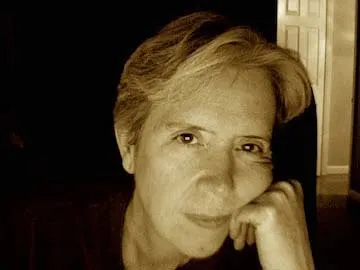
Mary Lynn Reed's fiction has appeared in Mississippi Review, Colorado Review, The MacGuffin, Litro Magazine, Smokelong Quarterly, and Wigleaf, among other places. She has an MFA in Creative Writing from The University of Maryland, and she is co-Editor of MoonPark Review.
Be sure to check out "Variations" by Mary Lynn Reed in Issue One of Orson's Review.