
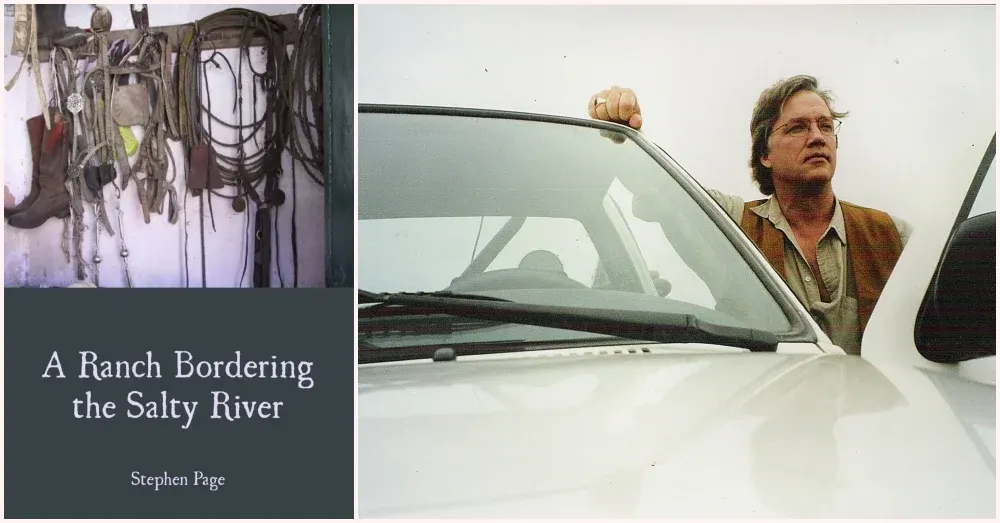
Recently, we had the pleasure of reviewing Stephen Page's book of poetry, A Ranch Bordering the Salty River. Stephen was also kind enough to sit down and talk shop with us, the back and forth of which you'll find below.
Enjoy, check out the review, and be sure to keep up with Stephen's latest, over on Twitter.
*This interview involves Orson's Publishing (OP) and Stephen Page (SP).
OP: What’s your writing process like? What about your revision process?
SP: My writing process depends mostly the upon the genre, but is also subject to place, the day, or the occasion. Usually, for poetry or fiction, the idea will just come to me, and I will go to a café, or sit on a park bench, or pull the car over to the side of the road—then pull out my ever-present notebook, and scribble down a first draft. I have written on café napkins, matchbook covers, candy wrappers, or whatever is within reach at the time—like the palm of my hand or my forearm. If I am at home, I go directly to my office and sit at my desk and begin a first draft, either in my journal, notebook, or on the computer. For non-fiction, I do much more prewriting. I usually brainstorm, draft a thesis statement, sketch an outline, then start fleshing out the piece. I try to be at my writing desk (or specified writing place at the time) at the same time every day so I don’t have to search for the muse—the muse channels to me (but anyone with a family and/or paying job knows that cannot always be done). Sometimes I just free-write until something comes to me, then go through the processes mentioned above. Lately I have even written (or typed in) an idea or rough draft on my cell phone.
My revision process, for all genres, is basically the same. I read over the first draft, pen notes in red ink (red, so it is easier to see), then go to my computer and type in the second draft or the corrections. Then I print the document, read it, pen in the corrections, type in the corrections on my computer, print it up, read it, pen in the corrections, print it up . . . that may go on for as many as 50 times, but at least five or six times—depending on time constraints, deadlines, or how comfortable I feel with the result.
OP: What made you decide to pursue writing? Can it be whittled down to a moment?
SP: Yes. During my first semester at university, while I was reading “Intro to English Literature” for a comp class, I started arbitrarily writing original poems and short stories in the columns of the book, and in the blank pages at the back of the book. I looked over my poems and short stories and decided that writing was fun and that it was something I might want to keep on doing.
OP: What do you want most out of your literary community?
SP: Oh, just to share. I hope my writing reaches writers and readers who get something out of what I write, whether it is empathy or metaphysical, and that helps drive conversation.
OP: Can other genres achieve what poetry can achieve?
SP: Poetry is powerful. Its assonance, alliteration, internal or end rhyme, and rhythm of the words makes it easier (or not easier, depending on who you speak with) to memorize and follow. Songs use the same methods of pleasing the ears and entering our hippocampusi. But, all genres have their pluses and minuses. Theatre can be just as illuminating as poetry, as can fiction, non-fiction, opera, etc. So, all genres have the power to impact.
I think I slept little while the first drafts emerged. For two years. Lost about forty pounds during that period...
OP: Do you have a poem within A Ranch Bordering the Salty River that’s closer to your heart than the others?
SP: Yes, but, I would prefer not to preset the readers’ opinions. Reading is subjective and everyone has their own favorite.
OP: If you could share a cup of mate with one writer, alive or dead, who would it be?
SP: (To inform the members in the audience who might not know, mate is a loose-leaf tea, traditionally drunk from a dried squash gourd through a metal straw.)
I am told it is not good to meet your heroes, literary or otherwise. That being said, it might be a kick to sit down for a cup with Shakespeare.
OP: What about A Ranch Bordering the Salty River was a challenge for you to write?
SP: Only that as the poems were first appearing on paper, I was working full time on a ranch as an administrator, taking care of my family, and, at the same time, studying for my MFA. I think I slept little while the first drafts emerged. For two years.
Lost about forty pounds during that period, but I gained it all back as soon as I graduated. I edited the poems after graduation, had almost all of them published individually in lit journals, and had a selected few published in the book.
OP: What has your ranching experience been like? Does it stem back to your time in the states?
SP: I think I have ranching and farming in my genes. On both sides of my family tree there are people who farmed the land and ranched animals. And though I was used to working hard all my life (I held a job from the age of ten in addition to going to school full time), and even though I passed U.S. Marine boot camp, and had a strong work ethic imbued upon me by my parents, ranching was unique from anything else I had ever done. The tasks were physically grueling, and the work day was sunup to sunset, sometimes longer. It was laborious, to say the least—sweaty work with flies, mosquitoes, ants, and fleas biting you all day.
I found out first hand that pastoral and bucolic are not synonymous with idyllic. But don’t let that detract the reader from how beautiful it is to work on an eco-ranch—the fresh air, the quiet, the lakes, rivers, woods, and wildlife were magnificent. Birthing season was a wonderful time also, especially with all the calves and ponies leaping about at sunrise and sunset. Not to mention that being far away from traffic and horns blaring all day was a benediction. It was like existing inside the system the universe meant the earth to subsist.
OP: When was the last time you visited Michigan? What was the most Michigan-y thing you did while you were there?
SP: I visit as often as I can, as I have two sisters living there. I have to say the most Michigan-y thing I did on my last trip was go to a Detroit Lions game. Maybe that or sitting around a campfire and grilling steaks deep inside the central-north woods. Or perhaps it was fishing on a lake. Hanging out at a cider mill was cool. Michigan has a lot to offer.
OP: How important of a role do you think books play in the future?
SP: I think people will be reading paper-paged books for a few decades at least, mostly because written language is a norm in society, and books have over the last many centuries, become a part of our lives. Additionally, storytelling has always been a source of entertainment, cultural learning, and socialization (based in the oral tradition). We may move completely to digital books sooner than we think (for transport convenience and because of pulp supply depletion—most people are reading on tablets and cell-phones regularly already), or we may move to some form of audio-digital-visual-virtual reality books (if they can still be called books at that point).
But storytelling and reading/listening to the stories will always be around. It is a part of what makes us human. A way of passing on traditions and studying history.
OP: What does a revolutionary book look like today?
SP: Good question. I think “revolutionary,” if it is referred to here as “groundbreaking,” or “innovative,” is a temporal term. What is advanced now is passé next year, or ten years from now. But for now, currently, this moment, or this decade, maybe just writing a mix-genre book, style wise, is the avant-garde.
If you are speaking about politics when you use the term “revolutionary,” that is another story.
OP: Where can readers find your work?
SP: Book-wise, on Amazon, Barnes & Noble, Goodreads, and the Finishing Line Press website. Also, go in or call your local bookstore and ask if one of my books is there (titles: A Ranch Bordering the Salty River and The Timbre of Sand).
For some of my single poems, short stories, essays, or literary criticism, you may find most of them posted on my website.
Now available at Amazon, Barnes & Noble, and Finishing Line Press.
CLICK HERE TO READ OUR REVIEW
"In this way, Page seems to invite us into this world, offer us a chair he’s built by hand and ask us to stay a while, to share some mate, to breathe."
-Garrett Dennert