
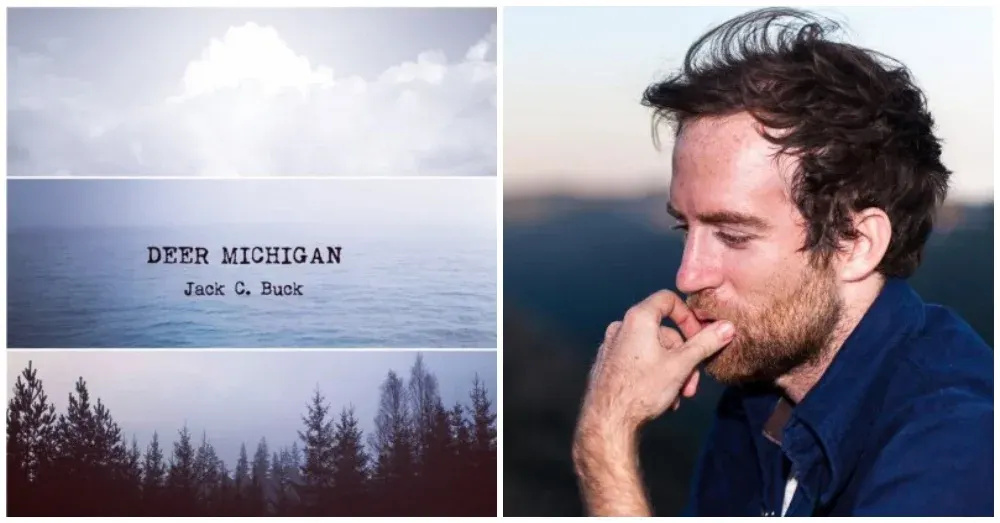
Recently, we had the pleasure of reviewing Jack C. Buck's collection of micro-fiction, Deer Michigan. Jack was also kind enough to sit down and talk shop with us, the results of which you'll find below.
Enjoy, check out the review, and be sure to keep up with Jack's latest, over on Goodreads and on Twitter.
*This interview involves Orson's Publishing (OP) and Jack C. Buck (JB)
OP: Do you have an audience in mind when you write?
JB: I hope my writing comes across in a manner of simplicity. In doing so, I try to write in a tone just about everyone can hear. Short fiction is accessible, the to-the-point structure can bridge the gap for someone who doesn't have the patience and/or time to read at length. People are busy, life is at a much higher pitch in 2017. Sure, my friends and family would be nice enough to read a 350-page novel, if I wrote one, but I would probably feel guilty about making them do so. If they did read it, I wouldn't charge them anything, I might even pay them out of gratitude, that's for sure, and probably say sorry while slowly backing away, receding down the hallway. Just kidding, novels are great.
What's really great is when you get a reluctant reader of fiction to read fiction. Sometimes they get into it, and tell you, hey, I liked that. For instance, for the most part, my father only reads non-fiction, so it was neat to show him the world of fiction. A lot of my fiction is grounded in reality because I like the idea of possibly convincing strictly non-fiction readers that the two -- fiction and non-fiction -- in a lot of ways are one and the same. Institutions like to give labels and names for categorizing purposes. But life becomes much more interesting when you blend the two.
OP: What is it about flash fiction that appeals to you?
JB: The short form makes it easy for readers to get in and out. If the reader likes a story - good, great; however, if the reader doesn’t care for a particular story much, then, well, at least they didn’t waste too much time on it. I feel bad wasting people’s time. There are so many phenomenal books out there to be read and we only have so much time. Who am I to monopolize the shelf space at a bookstore?
OP: What do you hope your readers will take from your book?
JB: Most of all, perhaps it will inspire someone to create something. It’s important to have an outlet. To make something is vital to the human spirit - whether that’s painting, dancing, photography, cooking, planting, writing, raising a family, singing, fixing something, teaching something - it’s all a form of creation. The world needs you and will listen more than ever these days.
OP: Why do you write?
JB: I find it difficult not to. Admittedly, I wish I didn’t think about it as much as I do. Sometimes it can be annoying thinking about writing. But if I had to pin it down to a reason it would be because I’m terrified of forgetting. Or, better said, I wish to honor life. Writing is a way I can do that.
I think it is quite similar to why people enjoy taking pictures of places and moments they have experienced, or for the reason one plays a particular song on a jukebox at their favorite bar - it’s all to feel and remember, to hang on for a little while longer.
OP: What drew you to Denver, Colorado?
JB: There are a lot of reasons, but most of all, I wanted to head west and Colorado seemed like the next best spot. California was too far away, and I wasn’t interested in living in Iowa or Nebraska. Although, going to writing school at Iowa’s Writers’ Workshop would be great.
On a practical reasoning, at the time some of my family members were residing in Denver, so that made the transition easy enough. Also, it always helps with the relocating when you have a friend or two coming along with you.
It was all very new and exciting. I wasn’t escaping or running away from anything by leaving Michigan, I just felt like I would evolve into a better version of myself by leaving my comfort zone.
OP: When was the last time you visited Michigan? What was the one Michigan-y thing you had to do while you were in town?
JB: Last summer I drove out to the lake and camped at Nordhouse Dunes. The weather was perfect all day. Surprisingly, no one else was out there camping. Three in the morning a lightning storm came across the lake, resulting in having to navigate three miles through the woods in order to sleep in the back of the van. I forgot to pack my headlamp for the camping trip, so I was left with a barely functioning flashlight I purchased from a gas station earlier that morning. The wind through all those trees was the loudest I’ve ever heard. It poured down rain moments after just arriving to the van. Perfect trip.
OP: You’ve cited Richard Brautigan as an influence. In Deer Michigan, there’s a story toasting Jim Harrison. What are some of your other influences as a writer?
JB: Some of my other favorites are Lydia Davis, Peter Orner, Louis Jenkins, Stuart Dybek, Haruki Murakami, Robert Bly, and Ernest Hemingway before he became an egomaniac. It sort of sounds like when someone says about a band, I liked them before the went over to that other record label.
When I was young, selfish, and naive, it didn’t bother me if a particular artist was kind of an asshole - I just thought, whatever, that goes with being in the field and gaining that status. Now their actions do have a direct correlation to my feelings of their work. One could argue it doesn't matter whatsoever about my feelings, I get that and agree with that stance, almost. Yet, in the morally and spiritually bankrupt world we live in, it feels best to surround myself with well-intentioned people, whether that person is living or dead.
OP: In Deer Michigan, your poetic background really shines through. Does your poetry influence your fiction? Does your fiction influence your poetry?
JB: My favorite genre of writing is prose poetry. Nine times out of ten when I’m writing a piece, I’m writing it down in the voice and sound of poetry. While in that writing, if I find what I have written to be of longer in length to my norm, then I rethink the writing to see if it would be more effective as a story with characters and plot.
It felt like all my friends were writing it and I was just there to be the one to write it down.
OP: You explore different points of view in this collection. Which do you like to write in most – first person, second person, or third? Why?
JB: I like to get rid of the restrictions of a linear timeline within a story. Not to confuse the reader, but changing point of view of inner and outer voice allows for more inner dialogue to come to surface. Not following the standard parameters of writing is my aim.
OP: Baseball plays an important role in a few of the stories in Deer Michigan. How does baseball factor into your everyday life?
JB: I started playing baseball when I was three or four years old. The game has stuck with me ever since. It’s a long game with a lot of time in between. It’s a lot like life.
OP: Do you have a story within the collection that’s closer to your heart than the others?
JB: “Home” is one of my favorites. I wrote that piece in two or three minutes in one-take. It felt like all my friends were writing it and I was just there to be the one to write it down.
OP: What’s your revision process like?
JB: I email my friend and he tells me if I’m onto something or not. When he likes a particular piece, I take that one more seriously. I try to make it the best I can. It all builds up, line by line - my technique of writing line by line comes from starting off with a poetic background.
It's difficult for me to see a story as a whole before I start writing. It's not until at least halfway through that I see where it's going direction-wise. I stop with a piece once I feel like I am just adding more words for the sake of having more words. A good test I put my writing through is, "How does it sound read aloud?" What I do is record myself reading the story or poem on my phone, then play it back a couple times until I fix what I need to fix. It's a great editing tool.
OP: What made you decide to pursue writing? Can it be whittled down to a moment?
JB: In college a lot of my friends were musicians who played shows with their bands. They would play around town in front lawns, garages, at the record store, etc. I didn’t know how to play an instrument. I wanted to participate and add something to the community, so I started writing poems. My friends were all so thoughtful and encouraging, despite my belief, they kept telling me to write more. Once I wrote a poem I was proud of, I asked if I could read them something at the next garage show.
OP: What do you want most out of your literary community?
JB: For the MFA community, the general public, and DIY writers to come together for readings. It seems like they are separate. I have no idea why. Perhaps it has something to do with crossed communication lines.
OP: Favorite TV show you’re watching right now?
JB: Just finished watching The OA. The new season of Homeland comes out soon. College basketball is in full swing. The winter months are good for TV.
OP: Outside of books, where, and how, do you find inspiration to write?
JB: When I see other people creating stuff, it makes me want to stop being lazy about my goals.
OP: What are you currently working on?
JB: I’ve written some more micro fiction since the publication of my book, which is fun. I didn’t think I would write anything for a while, but the book coming out has given me motivation to keep going. I don’t take it all too seriously. As soon as it loses its fun I’m out. There are plenty of other things to do in life.
OP: Where can readers find you?
JB: In Michigan you can buy my book at my favorite bookstore: Schuler Books. If you’re in Denver, you can purchase my book at two local bookstores: Mutiny Info Cafe and Kilgore Books. And, of course, Deer Michigan can be purchased online.
Now available at Barnes & Noble, Amazon, and Schuler Books & Music.
Click here to read our review
"And it’s in this execution that the aforementioned themes are handled not only with honesty, but with rays of hope—it’s there, in the silences, in the walls and floorboards of the micro houses Buck has built in Deer Michigan."
- Garrett Dennert